Nations League 13th November 2026 - My Picks
1% Moldova to win vs Kazakhstan at 41c (good to 43c)
1% Serbia +1.5 vs Germany at 44c (good to 47c)
1% Luxembourg not to win vs Estonia at 61c (good to 64c)
1% The Dutch not to win vs Greece at 38c (good to 42c)
1% Switzerland to win vs Slovenia at 57c (good to 62c)
1% Slovenia vs Switzerland no on both teams to score at 61c (good to 64c)
1% Faroe Islands +1.5 vs Slovakia at 52c (good to 55c)
Moldova vs Kazakhstan is the early kickoff so I will start with that.
Moldova vs Kazakhstan
Moldova play a compact defensive style under Lilian Popescu and come up against Kazakhstan under John van 't Schip, who is taking Kazakhstan away from their more traditional defensive approach and into a positional style based on principles of Dutch football. This is easier said than done at international level where access to players that fit the system and playing time to get them up to scratch is limited. These teams have already played each other earlier in the group, with Moldova winning 2-1 away from home in a game where their compact shape was able to limit Kazakhstan's chances as they created danger at the other end. Both teams need a win to keep their playoff hopes alive and so I am sceptical of the current draw price being that high; there are incentives to take risks towards the end of the game if it is level. I think said risks favour Moldova as their back five is well suited to preventing the kind of overloads positional systems rely on, especially with Kazakhstan still being early in implementing this system. I got Moldova at 35c and it has since gone up to 41c, so I think we are getting into marginal value but I would have Moldova at least level with Kazakhstan from a power ratings perspective and that generally implies a home advantage of a quarter of a goal, so that is why I have my good to line at 43c. I wouldn't chase this position if you can't get a good entry.
Serbia vs Germany
It would be easy to look at Serbia's 2-0 loss in Germany which could easily have been an even bigger win for Germany. A large part of that was Serbia deploying a 5-4-1 which prevented them from launching any meaningful attacks as Germany's gegenpressing interrupted their buildup and it's very hard to generate attacks with a lone man up front. Tonight's game will be played behind closed doors for an audience of 5,000 Serbian children and teachers due to a ban on Serbian fans attending the game. Serbia manager Veljko Paunović has indicated that Serbia were more in the game against Germany when they played more aggressively later in the game. The expected lineup is a 5-3-2 and an intent to press against the Germans rather than defend and hope for a counterattacking opportunity. Germany under Jürgen Klopp are still early in implementing his gegenpressing system and so Serbia are taking a risk to give themselves a chance in the game. I would say this will help Serbia find the gaps behind Germany's press more easily and five at the back still gives them a viable route to not getting overloaded on the flanks.
Luxembourg vs Estonia
Luxembourg deploy a positional style under Jeff Strasser and they come up against Estonia managed by Jürgen Henn who plays a compact defensive style with three centre back. When these teams met in Tallin, it was a 1-0 win for Estonia where they took an early lead and defended it for the rest of the game. Luxembourg are favoured by almost a quarter of a goal but I think Estonia are well set up to make the buildup very difficult for Luxembourg. Even though Estonia spent most of the game defending a lead, they still had a clear chance creation edge against Luxembourg. I think Estonia are likely to keep this a close game.
The Dutch vs Greece
The Dutch are still early on to implementing their system under Xavi, their first non Dutch manager in almost fifty years. Xavi was part of the infamous Barcelona team of the 2000s and 2010s and whose club tactical ideology is heavily influenced by Johan Cruyff, an integral part of the Dutch football revolution of the 1970s. Greece under Ivan Jovanović play a very compact defensive style with quick transitions. They have successfully got results against both the Dutch and Germany by keeping things tight at the back and then attacking the space behind these teams when their attacks break down. They're underdogs by almost a goal and I think that is a bit much for a very stubborn Greece team against a Dutch side that is still developing its system under Xavi.
Slovenia vs Switzerland
Both teams have injuries that are important to their attack and so I am not expecting a game full of explosive attacks. Switzerland under Murat Yakin have a positional style that creates chances through wide overloads while Slovenia under Boštjan Cesar have a compact defensive style that looks to hit on the break. Something that Switzerland are very effective at is preventing those breaks and that was a large part of how they were able to reach the World Cup quarter finals where they lost to Argentina after spending a lot of time with ten men. Switzerland conceded their only goal of the campaign so far to Slovenia but I'm not convinced that they present a consistent enough threat against them, which is why I'm going for no on both teams to score. I think Switzerland will be able to generate enough out on the flanks to justify taking them to win at a price in the high 50s.
Slovakia vs the Faroe Islands
Slovakia have shown the ability to manipulate the space around a defensive team as they did against Moldova but the Faroe Island are a very stubborn opponent indeed. They have only lost one game by more than a goal in the past two years, that being to Croatia and they have been very good at grinding out better results than most would expect for an island nation of around 55,000 inhabitants. The first game between these sides was a very disciplined defensive affair from the Faroe Islands, leading to a 1-1 draw and although Slovakia are at home in this game, I don't think it will be a straightforward evening for them. A draw would be enough for Slovakia to win the group so I wouldn't be opposed to taking the Faroe Islands not to lose tonight's game.
Alright, let's see how these go.

You & Your Beautiful Families STAY SAFE Out There!!! Good Luck & Good Gamblin!!!!
ATS = Against The Spread
ML = Money Line
ALT = Alternate Spreads
TT = Team Total
SGP = Same Game Parlay
1Q, 2Q, etc. = Bet Is Only For That Individual Quarter
1H & 2H = Bet Is Only For That Individual Half
1/2-Unit = 50% Unit (.5 Units)
1/4-Unit = 25% Unit (.25 Units)
SPRINKLE = At Your Discretion (DON'T GO CRAZY!!!!)
THESE ARE NOT SPORTSPICKS "OFFICIAL PICKS"
ALL MY ODDS COME FROM DRAFTKINGS
Crick's Picks Results: Week 10/YTD
Week 10
2-0 (5-Unit Plays)
0-3 (3-Unit Plays)
3-4 (2-Unit Plays)
1-2 (1-Unit Plays)
College Football: Week 10 - Overall = -3.44 Units
Year To Date
2-2 (5-Unit Plays)
9-13 (3-Unit Plays)
36-35-1 (2-Unit Plays)
2-0 (1-Unit Plays)
**0-1 ...
Two conflicting trends dictate the Senate outcome in 2026. The map heavily favors Republicans, as the competitive Senate seats up lean heavily Republican. By contrast, the election context heavily favors Democrats, with war, recession, realignment and scandal tipping in their direction. A deeper dive reveals why prediction markets still likely undersell Democratic prospects.
First, the idea that Senate midterms favor the party out of power in the White House is belied by both recent and a century of history of Senate elections. Unlike the House, only a third of Senate seats face election in any midterm, and that map dictates outcomes unless the election context is particularly bad for the incumbent party.
Consider that the highly unpopular Biden didn’t lost any net Senate seats in 2022 and Trump added Senate seats in the Democratic friendly cycle in 2018. Equally, Clinton didn’t lose net Senate seats in 1998 nor did W. in 2002. Even low-approval election cycles like 1966 and 1982 didn’t produce a big swing in the Senate. Indeed, since 1934, the party in power only lost 10% or more of their Senate seats (4+) less than half of the time. Democrats need a flip of exactly that — at least 4 Senate seats — to retake power in the Senate.
Then take a look at the map, and you can see the reason for optimism in GOP circles and some traders in the prediction markets. Only 2 GOP-held seats are in states Trump won by less than double digits, while 2 Democratic-held seats are in states Trump won, and one of those GOP held seats features a long-time incumbent who typically runs double-digits ahead of the GOP norm (Collins in Maine). This is why the GOP entered the year believing odds of losing the Senate were remote, and the prediction markets mostly concurred.
But this ignores the counter-trend: the degree of election dismay with the incumbent party in the White House, and the reasons for that dismay. Presidential job approval has not been a neat proxy for Senate midterms because it depends on the reason for that dissatisfaction in the electorate. Four factors drive Senatorial midterms: war, recession/cost of living, realignment, and scandal. When two of those four factors are not present and don’t dominate, then the incumbent party’s odds of losing 4+ Senate seats drops to less than 20%. By contrast, when two of those four factors are present and do predominate, then the odds of the incumbent party losing 4+ Senate seats rises to 100%. Indeed, the median number of Senate seats lost when some combination of war, recession, realignment and scandal, are present, the White House party loses at least 8 Senate seats.
A few examples: while FDR added Senate seats in 1934 midterms, he lost 9 in 1938 midterms due to the combination of recession and scandal (trying to stack SCOTUS). 1942 and 1946 gave us war and recession to cost Democrats 8 and 12 Senate seats alike. 1950 gave us war again and scandals concerning the war costing Democrats 5 Senate seats. 1958 gave us recession and scandal, costing Ike 15 Senate seats. While JFK added Senate seats in 1962 and Nixon added Senate seats in 1970, only Watergate and stagflation in 1974 or the combination of Iran Contra and vulnerable class of 1980 incumbents cost the incumbent party 4 or more Senate seats until the realignment election of 1994, where evangelicals shifted their down-ballot voting to the GOP en masse. It took war and scandal in 2006 to see the Senate switch 4+ Senate seats again.
That’s the story of 2026: a very GOP favorable Senate map versus a very Democratic friendly election cycle. The GOP enters election season with all four factor present: war, recession/cost of living, realignment, and scandal. The Iran War was already deeply unpopular, and it’s impact on the economy in gas and diesel prices turns Americans sour on their current economic prospects, as wages fall behind, housing and health care feel increasingly unaffordable, labor force participation continues to drop, the the mirage of AI keeps the GDP just above a technical recession. The Epstein scandal remains one of the worst scandals in American political history, and Trump managed to associate himself deeply with the scandal in his handling of it. Then the realignment, as the new Trump 2024 voters joined the Obama-Trump converts of 2016 in abandoning GOP identity, already evident in surveys and primary participation.
A quintet of voter groups appear to be realigning away from the Republican brand — hispanic voters, black voters, industrial area voters, libertarian-leaning voters, and war-skeptical voters alike. This realigning electorate shows up disproportionately in key Senate contests. The war-skeptical voters in states like Maine, New Hampshire, Ohio, Michigan, Iowa, Montana, Nebraska, and Alaska (these are the states W failed to gain in between 2000 and 2004 due to the Iraq War before it even turned unpopular). The hispanic voters in states like Florida and Texas. The African-American voters in states like North Carolina and Georgia. The industrial voters in Ohio and Michigan. The libertarian leaving voters in states like New Hampshire, Alaska, Texas and Florida.
Thus, many of the states that seem “Safe” on the map are anything but, as their realigning electorates shift back against the Republican brand, with all of them having recent histories in electoral cycles of favoring Democrats or being true swing states. Take states like Florida and Texas where suburban margins began to erode for the GOP in the Trump era but countered that by massive margin shifts in hispanic and black precincts. Primary participation, voter identification, and public opinion surveys show those black and hispanic voters shifting back massively away from the GOP brand, which, given the erosion in some suburban areas and losses with younger generations, makes states Florida and Texas closer to competitive than double-digit leans.
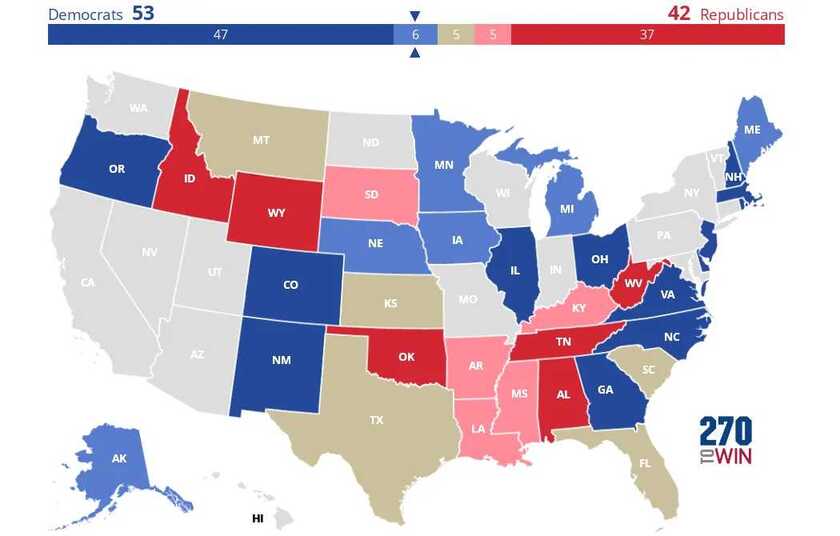
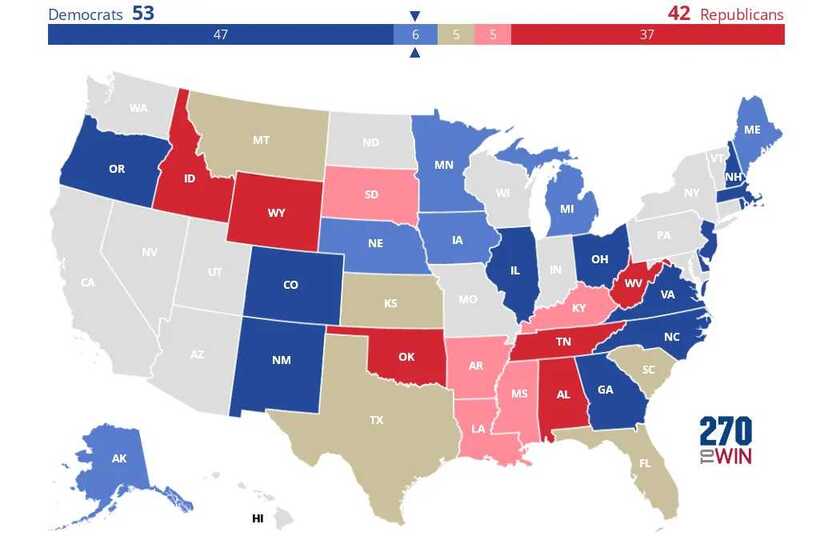
In big swing election cycles, even “safe” Senate seats can suddenly turn razor close, as Bob Dole found out in 1974, barely holding on to his Kansas seat before being the VP nominee two years later. Strong independent candidates in Kansas, Nebraska, South Dakota and Montana may pose a unique threat to GOP held seats, as the Nebraska race in 2024 showed, with Osborn running 17 points ahead of Harris’ margin in the state. Democrats field the much better candidate in Ohio with a proven track record of out-performing Democratic margins in the state, while the Texas GOP nominee faces abandonment from his own party after they spent over $100M bashing him in the state for a disliked party incumbent. Alaska primary results suggest the Democratic nominee already holds the edge in that ranked choice voting state, while the famed cross-over support for Collins in Maine appears to be fading with newer generations taking over the voter rolls. My current map would be as follows, with surprising closer-than-expected races in Montana, Kansas, Louisiana, Florida, Mississippi, South Dakota, South Carolina and Kentucky, and a median map of Democrats holding 53+ Senate seats after the 2026 elections.

If past is prologue, the map won’t save the GOP in 2026, and an ever bigger tsunami may be incoming than anyone in Washington expects.