Thursday Night Football Review 19th November 2026
Well that wasn't close, was it?
Indianapolis Colts 3-26 Houston Texans
Before the game things looked really bad for the Colts but they went far worse than they could have expected. In the early stages things didn't look quite so disastrous. The game started with the Colts getting a return to around the 40 yard mark and Daniel Jones threw a 25 yard pass to Ashton Dulin, which got them right into field goal range. They weren't able to keep the drive going so they kicked a field goal for what would turn out to be their only points of the game. The Texans did not start off so hot, with CJ Stroud throwing an interception on the Texans' first drive, his fourth interception of the season. At this point, some may have begin to wonder if the Colts' pre game line of +12.5 wasn't so mad after all but they failed to turn the succeeding drive into anything more. When the Texans received possession again they drove it down the field before CJ Stroud paused in space and threw a rocket for Nico Williams to score the game's first touchdown. This was followed by another long pass from Stroud to put the Texans 14-3 up. The Colts continued to struggle and Houston went up 17-3 at half time.
The second half was where things went from bad to worse as although the Colts did not resume the bleeding immediately, they did take up field position in front of their own goal when the Texans punted out of touch around the 5 yard line. Daniel Jones struggled to advance the ball and on third and long he was tackled in the end zone for a safety. Indianapolis never looked like coming back after that as the Texans rolled on to an easy win. Daniel Jones has since been released by the Colts as he was benched for the closing stages of the game, a huge reversal for a quarterback who was sitting at 8-2 last year before he received a season ending injury. In retrospect, that -12.5 line for the Texans looks exceedingly generous.
As feared by Colts fans, their depleted secondary proved to be a big weakness for CJ Stroud to exploit. He didn't even need to pass for particularly many yards, he simply needed a few big plays to turn into touchdowns. Nothing about what the Texans did needed to be spectacular, it simply needed to be far enough ahead of the Colts' defence to advance the ball into the Colts' half and pick up manageable scoring opportunities. On the defensive side, the Texans' defence gave Jones very little room to manoeuvre and although he only got sacked twice, one of those times was in his own end zone. Jonathan Taylor never got his run game going as the Texans consistently had enough resources to split between Daniel Jones and the run, especially with Jones not presenting a credible rushing threat of his own.
When one side fails to provide answers to the questions the other side presents, that's when these kinds of games can snowball. The Colts' squad depleted by transfers and injuries certainly doesn't help that, but it does underline that when we get into double digit spreads with teams who have lost a lot of personnel, it is not merely a sheer drop in talent, it is also less cohesion when the replacements play with each other on the field and are not used to playing with each other week in week out. The Texans had not been blowing teams out so far this season and the Colts were keeping games close but this was a bad place and a bad time for the Colts to play the Texans and it showed in a game where it felt like everything was going wrong for the team in blue as Carley Irsay-Gordon watched the shambles unfold from the touchline.

You & Your Beautiful Families STAY SAFE Out There!!! Good Luck & Good Gamblin!!!!
ATS = Against The Spread
ML = Money Line
ALT = Alternate Spreads
TT = Team Total
SGP = Same Game Parlay
1Q, 2Q, etc. = Bet Is Only For That Individual Quarter
1H & 2H = Bet Is Only For That Individual Half
1/2-Unit = 50% Unit (.5 Units)
1/4-Unit = 25% Unit (.25 Units)
SPRINKLE = At Your Discretion (DON'T GO CRAZY!!!!)
THESE ARE NOT SPORTSPICKS "OFFICIAL PICKS"
ALL MY ODDS COME FROM DRAFTKINGS
Crick's Picks Results: Week 11/YTD
Week 11
1-1 (5-Unit Plays)
1-2 (3-Unit Plays)
4-2 (2-Unit Plays)
0-1 (1/2-Unit Plays)
College Football: Week 11 - Overall = +.3 Units
Year To Date
3-3 (5-Unit Plays)
10-15 (3-Unit Plays)
40-37-1 (2-Unit Plays)
2-0 (1-Unit Plays)
**0-1 (3-Unit ...
European Football 20th November 2026 - My Picks
1% Athletic Club vs Espanyol over 9.5 corners at 56c (good to 60c)
1% FC Köln +2.5 vs Bayern Munich at 41c (good to 45c)
1% Bayern Munich vs FC Köln over 10.5 corners at 54c (good to 57c)
After the conclusion of the Nations League group stage, we now return to European club football, with La Liga, the Bundesliga and Ligue 1 all returning tonight. The Premier League and Serie A will return tomorrow.
Athletic Club vs Espanyol
Athletic Club of Bilbao under Edin Terzić play a pragmatic, transition orientated style of football and come up against Espanyol, who more recently hired Eder Sarabia as their manager and he employs a positional style influenced by his time working under Quique Setién. Athletic Club are favoured by almost a goal and a half going into this game so I'm not sure about value there but what I am looking at is corner counts, as Athletic Club like to attack through their flanks, with runs by Nico Williams being ...
Two conflicting trends dictate the Senate outcome in 2026. The map heavily favors Republicans, as the competitive Senate seats up lean heavily Republican. By contrast, the election context heavily favors Democrats, with war, recession, realignment and scandal tipping in their direction. A deeper dive reveals why prediction markets still likely undersell Democratic prospects.
First, the idea that Senate midterms favor the party out of power in the White House is belied by both recent and a century of history of Senate elections. Unlike the House, only a third of Senate seats face election in any midterm, and that map dictates outcomes unless the election context is particularly bad for the incumbent party.
Consider that the highly unpopular Biden didn’t lost any net Senate seats in 2022 and Trump added Senate seats in the Democratic friendly cycle in 2018. Equally, Clinton didn’t lose net Senate seats in 1998 nor did W. in 2002. Even low-approval election cycles like 1966 and 1982 didn’t produce a big swing in the Senate. Indeed, since 1934, the party in power only lost 10% or more of their Senate seats (4+) less than half of the time. Democrats need a flip of exactly that — at least 4 Senate seats — to retake power in the Senate.
Then take a look at the map, and you can see the reason for optimism in GOP circles and some traders in the prediction markets. Only 2 GOP-held seats are in states Trump won by less than double digits, while 2 Democratic-held seats are in states Trump won, and one of those GOP held seats features a long-time incumbent who typically runs double-digits ahead of the GOP norm (Collins in Maine). This is why the GOP entered the year believing odds of losing the Senate were remote, and the prediction markets mostly concurred.
But this ignores the counter-trend: the degree of election dismay with the incumbent party in the White House, and the reasons for that dismay. Presidential job approval has not been a neat proxy for Senate midterms because it depends on the reason for that dissatisfaction in the electorate. Four factors drive Senatorial midterms: war, recession/cost of living, realignment, and scandal. When two of those four factors are not present and don’t dominate, then the incumbent party’s odds of losing 4+ Senate seats drops to less than 20%. By contrast, when two of those four factors are present and do predominate, then the odds of the incumbent party losing 4+ Senate seats rises to 100%. Indeed, the median number of Senate seats lost when some combination of war, recession, realignment and scandal, are present, the White House party loses at least 8 Senate seats.
A few examples: while FDR added Senate seats in 1934 midterms, he lost 9 in 1938 midterms due to the combination of recession and scandal (trying to stack SCOTUS). 1942 and 1946 gave us war and recession to cost Democrats 8 and 12 Senate seats alike. 1950 gave us war again and scandals concerning the war costing Democrats 5 Senate seats. 1958 gave us recession and scandal, costing Ike 15 Senate seats. While JFK added Senate seats in 1962 and Nixon added Senate seats in 1970, only Watergate and stagflation in 1974 or the combination of Iran Contra and vulnerable class of 1980 incumbents cost the incumbent party 4 or more Senate seats until the realignment election of 1994, where evangelicals shifted their down-ballot voting to the GOP en masse. It took war and scandal in 2006 to see the Senate switch 4+ Senate seats again.
That’s the story of 2026: a very GOP favorable Senate map versus a very Democratic friendly election cycle. The GOP enters election season with all four factor present: war, recession/cost of living, realignment, and scandal. The Iran War was already deeply unpopular, and it’s impact on the economy in gas and diesel prices turns Americans sour on their current economic prospects, as wages fall behind, housing and health care feel increasingly unaffordable, labor force participation continues to drop, the the mirage of AI keeps the GDP just above a technical recession. The Epstein scandal remains one of the worst scandals in American political history, and Trump managed to associate himself deeply with the scandal in his handling of it. Then the realignment, as the new Trump 2024 voters joined the Obama-Trump converts of 2016 in abandoning GOP identity, already evident in surveys and primary participation.
A quintet of voter groups appear to be realigning away from the Republican brand — hispanic voters, black voters, industrial area voters, libertarian-leaning voters, and war-skeptical voters alike. This realigning electorate shows up disproportionately in key Senate contests. The war-skeptical voters in states like Maine, New Hampshire, Ohio, Michigan, Iowa, Montana, Nebraska, and Alaska (these are the states W failed to gain in between 2000 and 2004 due to the Iraq War before it even turned unpopular). The hispanic voters in states like Florida and Texas. The African-American voters in states like North Carolina and Georgia. The industrial voters in Ohio and Michigan. The libertarian leaving voters in states like New Hampshire, Alaska, Texas and Florida.
Thus, many of the states that seem “Safe” on the map are anything but, as their realigning electorates shift back against the Republican brand, with all of them having recent histories in electoral cycles of favoring Democrats or being true swing states. Take states like Florida and Texas where suburban margins began to erode for the GOP in the Trump era but countered that by massive margin shifts in hispanic and black precincts. Primary participation, voter identification, and public opinion surveys show those black and hispanic voters shifting back massively away from the GOP brand, which, given the erosion in some suburban areas and losses with younger generations, makes states Florida and Texas closer to competitive than double-digit leans.
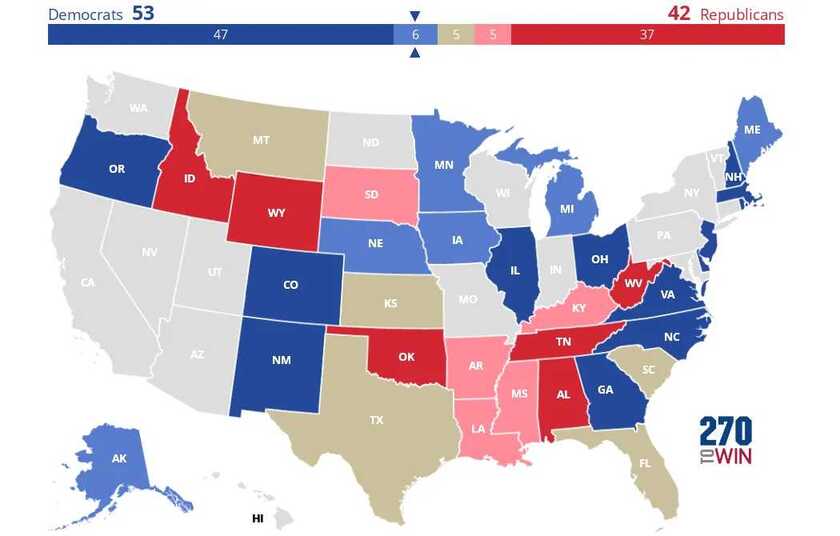
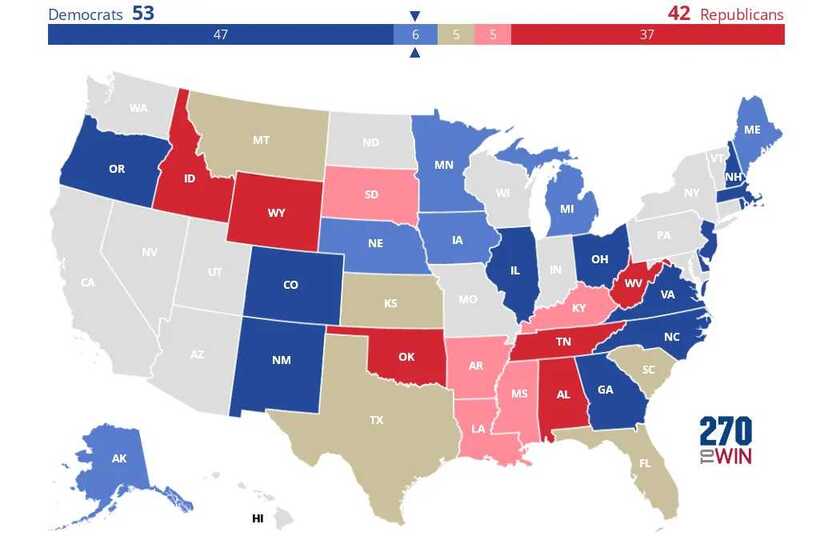
In big swing election cycles, even “safe” Senate seats can suddenly turn razor close, as Bob Dole found out in 1974, barely holding on to his Kansas seat before being the VP nominee two years later. Strong independent candidates in Kansas, Nebraska, South Dakota and Montana may pose a unique threat to GOP held seats, as the Nebraska race in 2024 showed, with Osborn running 17 points ahead of Harris’ margin in the state. Democrats field the much better candidate in Ohio with a proven track record of out-performing Democratic margins in the state, while the Texas GOP nominee faces abandonment from his own party after they spent over $100M bashing him in the state for a disliked party incumbent. Alaska primary results suggest the Democratic nominee already holds the edge in that ranked choice voting state, while the famed cross-over support for Collins in Maine appears to be fading with newer generations taking over the voter rolls. My current map would be as follows, with surprising closer-than-expected races in Montana, Kansas, Louisiana, Florida, Mississippi, South Dakota, South Carolina and Kentucky, and a median map of Democrats holding 53+ Senate seats after the 2026 elections.

If past is prologue, the map won’t save the GOP in 2026, and an ever bigger tsunami may be incoming than anyone in Washington expects.