Sunday Night Football Review 22nd November 2026
I would like to start by announcing that the Vikings are a bunch of bums, and fraudulent to boot. Kirk Cousins should retire his gold chain in disgrace. Brian Flores should go back to the Miami Dolphins and co coach them with Mike McDaniels with a picture of JJ McCarthy leading the Giants to victory over the Jaguars to hammer home the flaccid nature of this defeat. And I didn't even have the Vikings to win or cover. No, what I found so irksome about this performance was that my over play didn't hit despite these teams putting up 38 points in the first half. I just needed 9 more points for the over to hit. We got just 7 second half points, from just the 49ers. How the hell did that happen?
Minnesota Vikings 10-35 San Francisco 49ers
Let's delve into this mess. The big question going into this game was how the free scoring 49ers offence would fare against the stingy Vikings defence. We got our answer on the first drive as the 49ers rolled down the field and scored the opening touchdown. The Vikings responded with a touchdown of their own on a long drive before the 49ers added a second touchdown quickly afterwards. Any fears that this was going to be a disgusting slog were put to bed. What were the 49ers doing that other teams had been struggling so badly to do? Brock Purdy was facing blitzes on about 70% of dropbacks but he was quick to recognise where the pressure was coming from and throwing it into the space left behind the blitz. What was crucial here was speed, Purdy was making the pass before the blitz could get to him. The 49ers didn't need to dominate the run, simply stay enough ahead of the pressure to take advantage of the spaces it left.
On the other side, it's not like Minnesota didn't create scoring opportunities, because they did. It's what they did with them that mattered. Kirk Cousins was able to pull off a decent number of passes but the Vikings run game did not consistently threaten San Francisco and so there was a limit to how deep the Vikings were getting down the field on each drive. Nonetheless, they had multiple opportunities to add more points on the board that they did. There were two missed field goals in the first half, though I would not be so harsh on the second one. It was for the NFL record of 71 yards and with the thinner Mexico City air, I think Will Reichard was going to do it, but it just fell short. Had that gone in that one second half touchdown would have been enough for the over to cover and I would be nowhere near as scathing of the Vikings as I am now.
I would like to return once again to the Vikings putting no points on the board in the second half. The managed sustain a drive into the 49ers half, well within field goal range, and faced a 4th and 13. 25 points down, Kirk Cousins went for it and fell short for a turnover on downs. There are circumstances where going for it on 4th down makes sense, such as short yardage or a touchdown would give you a credible route to winning the game while a field goal would mean certain defeat. Yet this 4th and 13 was a mini Hail Mary, and for what? To take it from a four score game to a three score game with the clock dwindling down? A field goal would also have made it a three score game and would have made no difference to attempting an onside kick. The Vikings stopped the 49ers next drive (as you would expect the Vikings defence to have enough confidence in itself to be able to do) and they carried out another drive, this time with Carson Wentz. This drive also got to within touchdown range before ending with Wentz attempting a 4th and 8 to similarly predictable results. The 49ers kneeled the game out to an emphatic win.
You may say I take particular umbrage to this result because I had the over, and you would be correct, yet this would brush over a more far reaching point. This game was the acid test of a Vikings team whose defence had allowed it to remain competitive and win while having an underwhelming offence. With Kirk Cousins on the field they finally had a quarterback who could offer a higher floor than both Kyler Murray and Carson Wentz. Broadly speaking he delivered that floor. Where things were off were the ceiling. It is easy to say in retrospect that this was a very bad matchup for the Vikings and I think the 49ers were the play here. Even with all that, to go for it on 4th and 13 with it not being clear it would be the final drive of the game calls into question what the point of it all was.
Data analytics may be able to tell you an estimated probability of a large sample of teams to convert against a similarly large sample of teams but no amount of analytics says go can tell you what the probability of your team specifically in these very particular circumstances against this exact team is right now. There is uncertainty to be navigated, as probability is an approximation of uncertainty as well as of sheer randomness. When push comes to shove, the play either works or it doesn't and the random side of it (such as fumble direction) is distinct from the uncertainty side of it (what response the defence has prepared to what they think the offence is going to do, for example). I don't know if those fourth and long decisions were being driven by data analytics or more first principles reasoning but neither case looked well founded. It looked like a Vikings team that was happier to be a gallant failure than it was to box clever and keep the game closer than they ultimately did. That would be the thing that would worry me most about the Vikings going into the later stages of the season.

*Note: all picks ok to 3% points higher than posted.
NFL
WASH-CIN
2% WASH +6.5 Bengals 52%
2% WASH-CIN UNDER 54.5 50%
1% WASH YES Bengals 28%
1% CIN RB BROWN TD NO 47%
1% CIN RB BROWN Longest Rush UNDER 12.5 54%
1% CIN QB BURROW Passing TDs UNDER 2.5 46%
1% CIN QB BURROW Rushing Yards UNDER 10+ 54%
1% CIN WR CHASE Receiving Yards UNDER 100+ 50%
SOCCER
2% BRENTFORD YES Everton 42%
2% MONZA +0.5 Fiorentina 50%
2% STLOUIS YES LAFC 36%
NBA
2% CHA +2.5 Grizzlies 50%
2% MEM-CHA UNDER 215.5 52%
2% IND +4.5 Thunder 49%
2% NO +3.5 Suns 51%
2% SAC +10.5 Spurs 50%
2% SA-SAC UNDER 224.5 53%
NHL
2% CALGARY +1.5 Senators 54%
2% FLAMES-SENATORS UNDER 5.5 49%
2% MAMMOTH-JETS UNDER 6.5 53%
2% COLUMBUS YES Devils 36%
NCAAB
2% UTMARTIN YES Temple 44%
Get an annual subscription for less than a dollar a day, as the most affordable subscription service in political forecasting, sports information, and prediction markets anywhere, in the top 1% of all subscription services in accuracy and profitability for the last half-decade. Enter discount code -- Thanks -- for an additional 25% off the annual subscription.
Two conflicting trends dictate the Senate outcome in 2026. The map heavily favors Republicans, as the competitive Senate seats up lean heavily Republican. By contrast, the election context heavily favors Democrats, with war, recession, realignment and scandal tipping in their direction. A deeper dive reveals why prediction markets still likely undersell Democratic prospects.
First, the idea that Senate midterms favor the party out of power in the White House is belied by both recent and a century of history of Senate elections. Unlike the House, only a third of Senate seats face election in any midterm, and that map dictates outcomes unless the election context is particularly bad for the incumbent party.
Consider that the highly unpopular Biden didn’t lost any net Senate seats in 2022 and Trump added Senate seats in the Democratic friendly cycle in 2018. Equally, Clinton didn’t lose net Senate seats in 1998 nor did W. in 2002. Even low-approval election cycles like 1966 and 1982 didn’t produce a big swing in the Senate. Indeed, since 1934, the party in power only lost 10% or more of their Senate seats (4+) less than half of the time. Democrats need a flip of exactly that — at least 4 Senate seats — to retake power in the Senate.
Then take a look at the map, and you can see the reason for optimism in GOP circles and some traders in the prediction markets. Only 2 GOP-held seats are in states Trump won by less than double digits, while 2 Democratic-held seats are in states Trump won, and one of those GOP held seats features a long-time incumbent who typically runs double-digits ahead of the GOP norm (Collins in Maine). This is why the GOP entered the year believing odds of losing the Senate were remote, and the prediction markets mostly concurred.
But this ignores the counter-trend: the degree of election dismay with the incumbent party in the White House, and the reasons for that dismay. Presidential job approval has not been a neat proxy for Senate midterms because it depends on the reason for that dissatisfaction in the electorate. Four factors drive Senatorial midterms: war, recession/cost of living, realignment, and scandal. When two of those four factors are not present and don’t dominate, then the incumbent party’s odds of losing 4+ Senate seats drops to less than 20%. By contrast, when two of those four factors are present and do predominate, then the odds of the incumbent party losing 4+ Senate seats rises to 100%. Indeed, the median number of Senate seats lost when some combination of war, recession, realignment and scandal, are present, the White House party loses at least 8 Senate seats.
A few examples: while FDR added Senate seats in 1934 midterms, he lost 9 in 1938 midterms due to the combination of recession and scandal (trying to stack SCOTUS). 1942 and 1946 gave us war and recession to cost Democrats 8 and 12 Senate seats alike. 1950 gave us war again and scandals concerning the war costing Democrats 5 Senate seats. 1958 gave us recession and scandal, costing Ike 15 Senate seats. While JFK added Senate seats in 1962 and Nixon added Senate seats in 1970, only Watergate and stagflation in 1974 or the combination of Iran Contra and vulnerable class of 1980 incumbents cost the incumbent party 4 or more Senate seats until the realignment election of 1994, where evangelicals shifted their down-ballot voting to the GOP en masse. It took war and scandal in 2006 to see the Senate switch 4+ Senate seats again.
That’s the story of 2026: a very GOP favorable Senate map versus a very Democratic friendly election cycle. The GOP enters election season with all four factor present: war, recession/cost of living, realignment, and scandal. The Iran War was already deeply unpopular, and it’s impact on the economy in gas and diesel prices turns Americans sour on their current economic prospects, as wages fall behind, housing and health care feel increasingly unaffordable, labor force participation continues to drop, the the mirage of AI keeps the GDP just above a technical recession. The Epstein scandal remains one of the worst scandals in American political history, and Trump managed to associate himself deeply with the scandal in his handling of it. Then the realignment, as the new Trump 2024 voters joined the Obama-Trump converts of 2016 in abandoning GOP identity, already evident in surveys and primary participation.
A quintet of voter groups appear to be realigning away from the Republican brand — hispanic voters, black voters, industrial area voters, libertarian-leaning voters, and war-skeptical voters alike. This realigning electorate shows up disproportionately in key Senate contests. The war-skeptical voters in states like Maine, New Hampshire, Ohio, Michigan, Iowa, Montana, Nebraska, and Alaska (these are the states W failed to gain in between 2000 and 2004 due to the Iraq War before it even turned unpopular). The hispanic voters in states like Florida and Texas. The African-American voters in states like North Carolina and Georgia. The industrial voters in Ohio and Michigan. The libertarian leaving voters in states like New Hampshire, Alaska, Texas and Florida.
Thus, many of the states that seem “Safe” on the map are anything but, as their realigning electorates shift back against the Republican brand, with all of them having recent histories in electoral cycles of favoring Democrats or being true swing states. Take states like Florida and Texas where suburban margins began to erode for the GOP in the Trump era but countered that by massive margin shifts in hispanic and black precincts. Primary participation, voter identification, and public opinion surveys show those black and hispanic voters shifting back massively away from the GOP brand, which, given the erosion in some suburban areas and losses with younger generations, makes states Florida and Texas closer to competitive than double-digit leans.
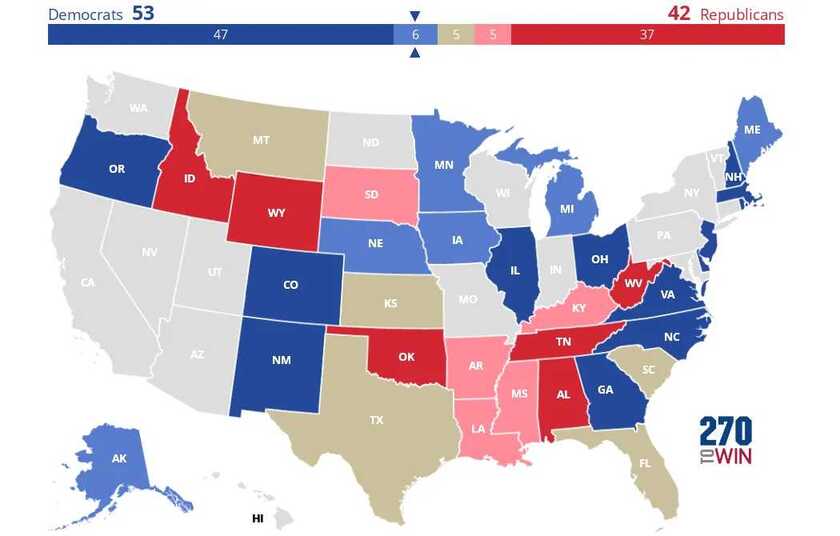
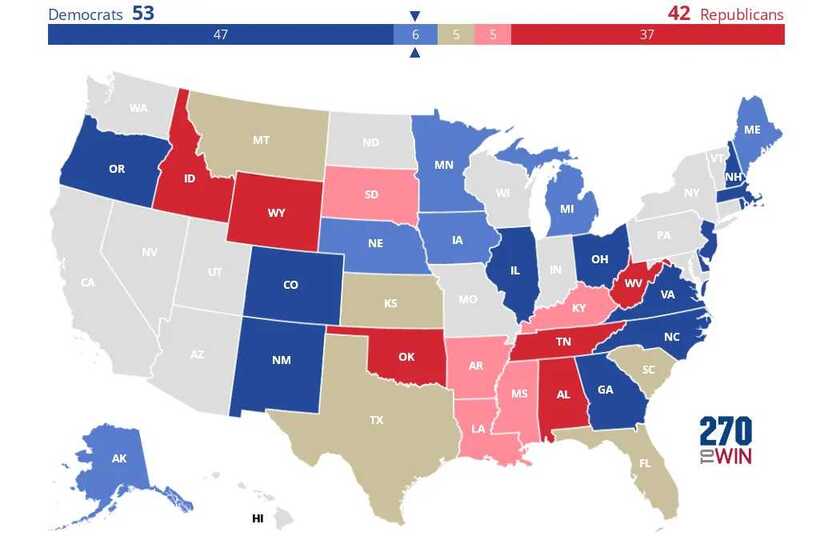
In big swing election cycles, even “safe” Senate seats can suddenly turn razor close, as Bob Dole found out in 1974, barely holding on to his Kansas seat before being the VP nominee two years later. Strong independent candidates in Kansas, Nebraska, South Dakota and Montana may pose a unique threat to GOP held seats, as the Nebraska race in 2024 showed, with Osborn running 17 points ahead of Harris’ margin in the state. Democrats field the much better candidate in Ohio with a proven track record of out-performing Democratic margins in the state, while the Texas GOP nominee faces abandonment from his own party after they spent over $100M bashing him in the state for a disliked party incumbent. Alaska primary results suggest the Democratic nominee already holds the edge in that ranked choice voting state, while the famed cross-over support for Collins in Maine appears to be fading with newer generations taking over the voter rolls. My current map would be as follows, with surprising closer-than-expected races in Montana, Kansas, Louisiana, Florida, Mississippi, South Dakota, South Carolina and Kentucky, and a median map of Democrats holding 53+ Senate seats after the 2026 elections.

If past is prologue, the map won’t save the GOP in 2026, and an ever bigger tsunami may be incoming than anyone in Washington expects.