




EPL
Leeds-West Ham DRAW +270
Newcastle +230 Watford
Southampton-Wolves DRAW +225
Arsenal-Tottenham DRAW +240
Crystal Palace +200 Brighton
NCAAF
Syracuse +6 Liberty
South Carolina +5 Kentucky
Boston College +1 1/2 Missouri
Stanford +5 UCLA
USC -11 Or. State
Florida State +2 Louisville
Ok. St. -5 1/2 K. St.
LSU -2 1/2 Miss. St.
Texas -8 Tex. Tech
Tennessee +19 Florida
Nebraska +5 Mich. St.
Arizona +29 Oregon
Clemson -10 NC St.
A&M -4 1/2 Arkansas
Notre Dame +6 1/2 Wisconsin
Tulane -3 UAB
Georgia Tech +14 UNC
Maryland -14 Kent St.
UMASS +36 Coastal Carolina
BYU -23 1/2 SFL
Troy -24 ULM
Rice -21 1/2 Tex Southern
Georgia Southern +14 ULL
1st Half LSU-Miss. St. UNDER 28
1st Half TN-FL UNDER 32
Nebraska-Michigan St. OVER 52
Syracuse +200 Liberty
South Carolina +175 Kentucky
Notre Dame +200 Wisconsin
Boston College +110 Missouri
Stanford +165 UCLA
Florida State +110 NCST
LSU -135 Miss. St.
Nebraska +170 Mich. St.
Florida UNDER 40 1/2
USC OVER 37 1/2
Miss. St. UNDER 27 1/2
Texas Tech UNDER 25 1/2
NC St. UNDER 17 1/2
Oregon UNDER 42 1/2
K St. UNDER 20
Texas A&M OVER 26 1/2
UNC UNDER 37 1/2
NFL
1st Half Colts +3 1/2 Titans
1st Half Washington +4 1/2 Bills
1st Half Jets +6 1/2 Broncos
1st Half Packers +3 49ers
1st Half Falcons +2 1/2 Giants
1st Half Panthers-Texans UNDER 21 1/2
1st Half Cardinals-Jags UNDER 24 1/2
1st Half Ravens-Lions UNDER 24
1st Half Chargers-Chiefs UNDER 27
1st Half Falcons-Giants UNDER 23 1/2
1st Half Bears-Browns UNDER 23 1/2
1st Half Seahawks-Vikings UNDER 27
Texans +8 Panthers
Jags +7 1/2 Cardinals
Lions +8 Ravens
Rams +1 1/2 Bucs
Vikings + 1 1/2 Seahawks
Panthers UNDER 25 1/2
Cardinals UNDER 30 1/2
Titans UNDER 27 1/2
Ravens UNDER 30 1/2
Bills UNDER 28 1/2
Chiefs UNDER 31 1/2
Giants UNDER 26 1/2
Browns UNDER 27 1/2
Jets OVER 14 1/2
Bucs UNDER 27 1/2
Seahawks UNDER 28 1/2
49ers UNDER 26 1/2
Texans +320 Panthers
Rams +110 Bucs
Vikings +105 Seahawks
Packers +155 49ers
In this edition of "Master Class", we're gonna look at Prediction Markets vs Sportsbooks, and why the Prediction Markets are the Future of Sports Betting!! Come join us, as we try to provide you with all the tools to STACK YOUR NICKELS TO THE CEILING!! Feel Free to drop any questions you have in the comments!! Hope This Helps My Friends!! Good Luck, Good Gamblin, & Have The Day You Deserve!!
-Crickett
Premier League 18th-20th September 2026
The final set of Premier League games before the three week international break.
Friday
Brentford 3-0 Chelsea - this game was a pick'em before kick-off with Brentford slightly favoured at a win price of 38c, game total set at just over 3 goals and both teams to score at 68c. Volatility was priced into this game not only through BTTS but also the draw line being 27c. The way this game played out was tighter than that. First half there were relatively few chances as Brentford played tight and looked to counter. Chelsea dominated possession throughout but went behind from a corner in the second half, set pieces being a recurring vulnerability for Chelsea so far this season. The second goal came from a Chelsea forward ball being intercepted by the Brentford defence, then moved forward rapidly and splitting Chelsea's defence for 2-0. The third goal from Brentford came from a ball across box that took a deflection for a tap in. From a chance creation ...
Two conflicting trends dictate the Senate outcome in 2026. The map heavily favors Republicans, as the competitive Senate seats up lean heavily Republican. By contrast, the election context heavily favors Democrats, with war, recession, realignment and scandal tipping in their direction. A deeper dive reveals why prediction markets still likely undersell Democratic prospects.
First, the idea that Senate midterms favor the party out of power in the White House is belied by both recent and a century of history of Senate elections. Unlike the House, only a third of Senate seats face election in any midterm, and that map dictates outcomes unless the election context is particularly bad for the incumbent party.
Consider that the highly unpopular Biden didn’t lost any net Senate seats in 2022 and Trump added Senate seats in the Democratic friendly cycle in 2018. Equally, Clinton didn’t lose net Senate seats in 1998 nor did W. in 2002. Even low-approval election cycles like 1966 and 1982 didn’t produce a big swing in the Senate. Indeed, since 1934, the party in power only lost 10% or more of their Senate seats (4+) less than half of the time. Democrats need a flip of exactly that — at least 4 Senate seats — to retake power in the Senate.
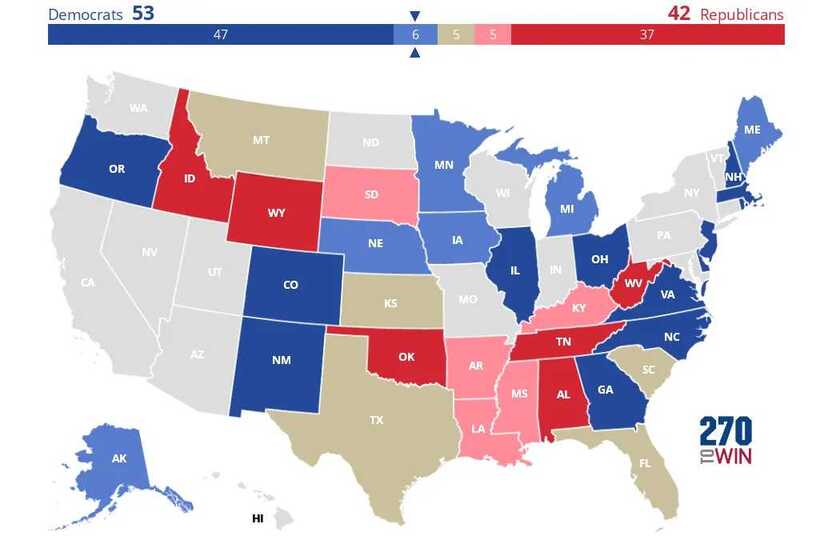
Then take a look at the map, and you can see the reason for optimism in GOP circles and some traders in the prediction markets. Only 2 GOP-held seats are in states Trump won by less than double digits, while 2 Democratic-held seats are in states Trump won, and one of those GOP held seats features a long-time incumbent who typically runs double-digits ahead of the GOP norm (Collins in Maine). This is why the GOP entered the year believing odds of losing the Senate were remote, and the prediction markets mostly concurred.
But this ignores the counter-trend: the degree of election dismay with the incumbent party in the White House, and the reasons for that dismay. Presidential job approval has not been a neat proxy for Senate midterms because it depends on the reason for that dissatisfaction in the electorate. Four factors drive Senatorial midterms: war, recession/cost of living, realignment, and scandal. When two of those four factors are not present and don’t dominate, then the incumbent party’s odds of losing 4+ Senate seats drops to less than 20%. By contrast, when two of those four factors are present and do predominate, then the odds of the incumbent party losing 4+ Senate seats rises to 100%. Indeed, the median number of Senate seats lost when some combination of war, recession, realignment and scandal, are present, the White House party loses at least 8 Senate seats.
A few examples: while FDR added Senate seats in 1934 midterms, he lost 9 in 1938 midterms due to the combination of recession and scandal (trying to stack SCOTUS). 1942 and 1946 gave us war and recession to cost Democrats 8 and 12 Senate seats alike. 1950 gave us war again and scandals concerning the war costing Democrats 5 Senate seats. 1958 gave us recession and scandal, costing Ike 15 Senate seats. While JFK added Senate seats in 1962 and Nixon added Senate seats in 1970, only Watergate and stagflation in 1974 or the combination of Iran Contra and vulnerable class of 1980 incumbents cost the incumbent party 4 or more Senate seats until the realignment election of 1994, where evangelicals shifted their down-ballot voting to the GOP en masse. It took war and scandal in 2006 to see the Senate switch 4+ Senate seats again.
That’s the story of 2026: a very GOP favorable Senate map versus a very Democratic friendly election cycle. The GOP enters election season with all four factor present: war, recession/cost of living, realignment, and scandal. The Iran War was already deeply unpopular, and it’s impact on the economy in gas and diesel prices turns Americans sour on their current economic prospects, as wages fall behind, housing and health care feel increasingly unaffordable, labor force participation continues to drop, the the mirage of AI keeps the GDP just above a technical recession. The Epstein scandal remains one of the worst scandals in American political history, and Trump managed to associate himself deeply with the scandal in his handling of it. Then the realignment, as the new Trump 2024 voters joined the Obama-Trump converts of 2016 in abandoning GOP identity, already evident in surveys and primary participation.
A quintet of voter groups appear to be realigning away from the Republican brand — hispanic voters, black voters, industrial area voters, libertarian-leaning voters, and war-skeptical voters alike. This realigning electorate shows up disproportionately in key Senate contests. The war-skeptical voters in states like Maine, New Hampshire, Ohio, Michigan, Iowa, Montana, Nebraska, and Alaska (these are the states W failed to gain in between 2000 and 2004 due to the Iraq War before it even turned unpopular). The hispanic voters in states like Florida and Texas. The African-American voters in states like North Carolina and Georgia. The industrial voters in Ohio and Michigan. The libertarian leaving voters in states like New Hampshire, Alaska, Texas and Florida.
Thus, many of the states that seem “Safe” on the map are anything but, as their realigning electorates shift back against the Republican brand, with all of them having recent histories in electoral cycles of favoring Democrats or being true swing states. Take states like Florida and Texas where suburban margins began to erode for the GOP in the Trump era but countered that by massive margin shifts in hispanic and black precincts. Primary participation, voter identification, and public opinion surveys show those black and hispanic voters shifting back massively away from the GOP brand, which, given the erosion in some suburban areas and losses with younger generations, makes states Florida and Texas closer to competitive than double-digit leans.
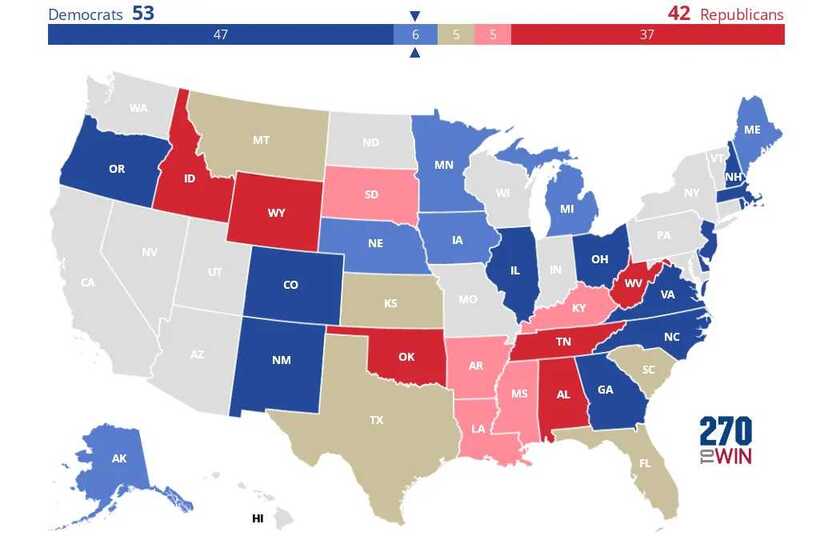
In big swing election cycles, even “safe” Senate seats can suddenly turn razor close, as Bob Dole found out in 1974, barely holding on to his Kansas seat before being the VP nominee two years later. Strong independent candidates in Kansas, Nebraska, South Dakota and Montana may pose a unique threat to GOP held seats, as the Nebraska race in 2024 showed, with Osborn running 17 points ahead of Harris’ margin in the state. Democrats field the much better candidate in Ohio with a proven track record of out-performing Democratic margins in the state, while the Texas GOP nominee faces abandonment from his own party after they spent over $100M bashing him in the state for a disliked party incumbent. Alaska primary results suggest the Democratic nominee already holds the edge in that ranked choice voting state, while the famed cross-over support for Collins in Maine appears to be fading with newer generations taking over the voter rolls. My current map would be as follows, with surprising closer-than-expected races in Montana, Kansas, Louisiana, Florida, Mississippi, South Dakota, South Carolina and Kentucky, and a median map of Democrats holding 53+ Senate seats after the 2026 elections.

If past is prologue, the map won’t save the GOP in 2026, and an ever bigger tsunami may be incoming than anyone in Washington expects.