


SportsPicks
Politics • Investing & Finance • Sports
All your sports information for those investing Vegas-style in the outcomes of sports games. Predicting games against the line in all sports, especially football, American and English style.
Interested? Want to learn more about the community?
Crick's Corner: The Legend of Andy Reid
  • It was a chilly night in the Meadowlands on December 30, 2012. Andy Reid's Philadelphia Eagles had just finished up a 4-12 campaign, and missed the playoffs for consecutive seasons for the first time in Reid's tenure as Head Coach. It wasn't very pretty either. The Eagles recovered an onside kick on the opening kickoff of the game, but that was as good as it would get for the folks from Philly. Michael Vick threw a pick two plays later, and the game was out of reach by halftime. Philadelphia went on to lose that game to the New York Giants 42-7. The writing was on the wall as far as the future of their Head Coach. He wouldn't be returning, and on December 31, 2012, Eagle's management decided to part ways with the winningest HC in franchise history. However, Reid's time on the sidelines wasn't finished. His remarkable career had simply reached its own "Halftime", and some of the best was still yet to come.

Early Years

  • Walter and Elizabeth Reid gave birth to Andrew Walter Reid on March 19, 1958 in Los Angeles, California. His mother was a very intelligent woman and respected radiologist in Southern California. Well-versed in Science and Mathematics, Reid credits his mother for his traditional "Book Smarts". His creative and artistic side was developed from his father Walter, who was a scenic artist in Hollywood designing backgrounds and props for television, film, and stage shows.
    Andy played youth sports in East Hollywood at Lemon Grove Recreation Center, where a man named Pete Arbogast was his youth basketball coach. Today, Arbogast is the radio announcer for the USC Football Team, and at one time was the play-by-play announcer for the Cincinnati Bengals.
    On December 13, 1971, a 13-year-old Reid participated in a "Punt, Pass, and Kick" competition during a Monday Night Football game between the Los Angeles Rams and the Washington Redskins. Reid, who was much bigger than the other kids competing, had to borrow a jersey and shoulder pads from Rams RB Lester Josephson because the equipment the team had secured for the other competitors wouldn't fit him. Although, Reid didn't win the competition, he still has the jersey and shoulder pads to this day. Not a bad consolation prize I suppose.
    In his teenage years, you could often find a young Andy somewhere inside Dodger Stadium where he worked as a peanut vendor. He would go on to attend John Marshall High School in LA, where he would become one of several famous alumni. Leonardo DiCaprio, Lance Ito, Heidi Fless, and Julia "Catwoman" Newmar all graduated from John Marshall, and the campus was also the location where the interior scenes for the movie "Grease" were filmed. Maybe, Reid was destined for greatness from the start...

College Years

  • After High School, Reid would go on to play Offensive Tackle at Glendale Community College in Glendale, California. He was planning on transferring to Stanford, but a knee injury deterred that. As fate would have it, BYU Head Coach Lavell Edwards really wanted Reid's teammate and best friend, Randy Tidwell, to come play in Provo. Edwards began recruiting Reid as well, in hopes he could help persuade Tidwell to become a Cougar with him. The move worked and both ended up at BYU.
    Reid didn't play much at BYU, but became a very serious student of the game. He was very analytical and constantly studying HC Edwards and Offensive Coordinator Doug Scovil. Reid was teammates with the likes of Jim McMahon, Steve Young, and Tom Holmoe, who has been the Athletic Director at BYU since 2005.
    In his Senior season, BYU won the 1980 Holiday Bowl against the SMU Mustangs and their legendary backfield featuring Craig James and future NFL Hall-of-Famer Eric Dickerson. Also known as the "Miracle Bowl", this game is widely considered as the "Greatest Comeback in College Football History"! Trailing 45-25, the Cougars scored 21 points in the final 2:33 that included recovering an onside kick, blocking a punt, and completing a "Hail Mary" to tie the game with zeros on the clock. The ensuing extra-point gave BYU the 46-45 victory, and their first Bowl win in school history. However, Reid's best days were still ahead of him.

Becoming an Offensive Genius

  • In Reid's Senior year at BYU, the Cougars led the NCAA in Total Offense (535.0 ypg), Passing Offense (409.8 ypg), and Scoring (46.7 ppg). Becoming one of the first true "Air-Raid" offenses, and laying a blueprint for how many of the modern offenses are ran to this day.
    After graduating from BYU in 1981, Reid accepted a job as a Graduate Assistant at his alma mater. Joining a coaching staff littered with brilliant football minds. Not only was he able to study under his former HC Edwards and OC Scovil, who had just led the nation in ALL of the most important offensive categories, but future NFL coaches Mike Holmgren and Norm Chow also shared a sideline with Reid in Provo. The Late GREAT Mike Leach, who played Rugby at the school, would even stop by film sessions and share his thoughts with the staff and Reid. Leach was never "officially" part of the BYU Football Program in any fashion, but is considered one of the greatest offensive minds in football history. He tragically, passed away in December 2022 from complications suffered from cardiac arrest, but you can rest assured he had a major influence on anyone he ever talked football with, Reid included.
    During this time at BYU is when Reid really began developing, what many people consider, one of the greatest offensive minds in the history of the game. After one year as a grad-assistant in Provo, Reid bounced around over the next 9 years at smaller schools. Serving as the O-Line Coach at four different institutions. However, in 1992, Reid got the shot he had been waiting for. He was hired onto the Green Bay Packers staff by his good friend and former colleague at BYU, Mike Holmgren. Coincidentally, this was the same season legendary QB Brett Favre made his way to Lambo.
    In 1995, Reid was promoted to Assistant O-Line and Tight Ends Coach, where he helped lead the Packers to a Super Bowl victory over the New England Patriots. In 1997, he became the Packers QB Coach and helped Green Bay get back to the Super Bowl where they would come up short this time, losing to the Denver Broncos in Reid's last Season with the Pack.

Fly Eagles Fly

  • The 1998 season was a disastrous one for the Philadelphia Eagles. They finished the year with a 3-13 record, and fired their Head Coach Ray Rhodes. Philadelphia's top target to replace Rhodes was Mike Holmgren, Reid's former boss, who had recently resigned from the Green Bay Packers. Holmgren ended up heading to Seattle to become the Head Coach/General Manager of the Seahawks, but not before he urged Eagle's owner Jeff Lurie to hire Reid.
    With a team that needed rebuilt from the ground up, Philly wanted a detail-oriented HC who could develop a winning culture. When Reid showed up to his interview with a 5-inch thick notebook he had put together, detailing how he would run the team if given the job, the Eagles knew they had their guy. On January 11, 1999, Andy Reid became the first Head Coach in NFL history to be hired to that position without first serving as an offensive or defensive coordinator.
    Reid's first major decision as HC was drafting dual-threat QB Donovan McNabb with the 2nd overall pick in the 1999 NFL Draft. In his first season, Philly went 5-11 and snapped a streak of 19 straight road losses. In year two, they flipped their record from the previous season going 11-5, and won the franchise's first playoff game since 1995.
    Year 3 was where things really started to take off for Reid's Eagles. In his 3rd season in 2001, Reid was named VP of football operations for the Eagles. Giving him "Last Say" over all things football, Philadelphia won their first of four straight NFC East Titles. They advanced to the NFC Championship in 2001, '02, '03, and '04. Losing the first three, before finally getting over the hump and making it to the Super Bowl. The 2003 Squad became the first team in NFL history to advance to the conference championship game after having been shut-out at home on opening day.
    The 2004 team would go on to clinch the #1 seed in the NFC and eventually make it to the Super Bowl after defeating the Atlanta Falcons 27-10 in the NFC Championship Game. However, they ran into some guy named Tom Brady in Super Bowl XXXIX, and lost a heartbreaker to the New England Patriots 24-21.

Not So Sunny in Philadelphia

  • In 2005, Reid passed Greasy Neale to become the winningest HC in Eagle's Franchise history. That season went down the drain, however, when starting QB Donovan McNabb went down with a season-ending injury early on in the '05 campaign.
    The 2008 season would be the 5th and final time an Andy Reid-coached Philadelphia team made the NFC Championship Game, where they would fall short once again. Losing to the Arizona Cardinals 32-25.
    Tragedy would strike the Eagle's just before the 2009 season started. Reid's Defensive Coordinator for his entire career, Jim Johnson, passed away on July 28, 2009 after battling melanoma. Devastating Reid, his players, and everyone throughout the entire organization. Johnson had to be admitted to the hospital just a few weeks after the NFC Championship loss the season before, and spent most of his last days there. Even though Reid had the overwhelming responsibilities of running an NFL team, he still drove 30+ minutes almost everyday after he finished up with his guys, just to check on his dear friend. The '09 team still managed to go 11-5 that season and advanced to the playoffs once again. However, Reid failed to win a first-round playoff game for the first time in his Head Coaching career.
    In 2012, Philly limped to a 4-12 record, the worst of Reid's HC tenure. That year also marked the first time the Eagles missed the post-season in consecutive seasons under Reid. On December 31, 2012, one day after that embarrassing 42-7 season-ending loss to the New York Giants, Eagle's owner Jeff Lurie announced the team would not be renewing Reid's contract. Reid was the longest tenured HC in the league, at the time, prior to his release.
    In his 14 year tenure with Philadelphia, Reid won 120 games, had a winning percentage of .609, and won 10 playoff games. All of which, were franchise records. He won 6 NFC East Titles, and made five trips to the NFC Championship Game, winning one. Unfortunately, he wasn't able to deliver a Super Bowl victory to a starving Philly fanbase.
    During his time with the Eagles, no other franchise earned more divisional round playoff appearances (7), and only Bill Belichick's Patriots had more appearances in Conference Championship Games (6), than Reid's squads (5). He sent 19 players to 44 Pro Bowl appearances, the highest total for any team during that span. None of those players had been named to a Pro Bowl prior to Reid being hired as HC.

Who Got Next??

  • Andy Reid was one of the hottest names on the coaching market even before he was given his walking papers in Philly. Most people thought Reid would end up with the Arizona Cardinals, and all signs pointed to that being the case. However, the Kansas City Chiefs had other plans. Chief's management met Reid at the airport, when he was about to board a flight destined for the desert. Kansas City interviewed Reid at the airport, and offered him the job on the spot. Needless to say, he didn't make it to that interview in Arizona, and the rest is history. Reid became the Chief's Head Coach on January 4, 2013 just four days after being let go by Philadelphia.
    In his first game as the Chief's HC, his squad defeated the Jacksonville Jaguars 28-2. It was the largest margin of victory on opening day, for Kansas City, since defeating the Denver Broncos 59-7 in 1963.
    Week 3 of that season, Reid returned to Lincoln Financial Field in Philadelphia for the first time since being fired as the Eagle's HC. As he walked onto the field before that Thursday Night game, he received a standing ovation from the Eagle's faithful. The Chiefs won that game 26-16, and started 9-0 in Reid's first season in KC. Tied for the best start in franchise history. However, that team lost 5 of their last 7 games finishing up the regular season at 11-5, and limped into the playoffs to face the Indianapolis Colts in the Wild-Card Round. After leading that game by 28 in the 3rd quarter, the wheels fell off and the Chiefs ultimately lost that game 45-44. Just the second time in Reid's career that he failed to win a first round playoff game.
    In 2014, Kansas City finished 9-7 but missed the post-season. In his third year with the team in 2015, they started 1-5 and his future with the team seemed very much in question. Not one to lie down without a fight though, Reid guided the Chiefs to a franchise best 11 straight wins, including their first playoff win since 1993, before losing 27-20 in the Divisional Round to the Patriots.

AFC Championships and Super Bowls

  • Kansas City had strong teams in both 2016 and 2017, winning consecutive Division Titles for the first time in franchise history. However, they bowed out of the playoffs before the Championship Round in both those seasons. In 2018, Reid led the Chiefs to their first of five consecutive AFC Championship Games .Losing, once again, to Tom Brady and the New England Patriots.
    Alas, in 2019, one of the winningest coaches in NFL history finally achieved what he had craved for so long. Andrew Walter Reid hoisted the Lombardi Trophy after his team defeated the San Francisco 49ers in Super Bowl LIV. Kansas City would return to the Super Bowl the following season, losing this time to the Tampa Bay Buccaneer's version of Tom Brady. The next season they would fall in the AFC Championship Game to the Cincinnati Bengals.

Is Andy Reid the GOAT??

  • Finally, we find ourselves back in the present. As Reid's Kansas City Chiefs will face his former employer, the Philadelphia Eagles in Super Bowl LVII on Sunday Night. He's already the winningest coach in Eagle's franchise history, and needs just one more victory to become the winningest coach in Chief's history. In his Head Coaching career, Reid has compiled a record of 268-154-1 (.635), including a 21-16 (.568) mark in the post-season. Between Philly and KC, he has won 13 Division Titles, currently having won 7 straight with the Chiefs. He's been a Head Coach in 10 AFC/NFC Championship Games, and is about to HC in his 4th Super Bowl, with 1 SB Title already to his credit. He's one of only 6 Head Coaches to win at least 1 Playoff Game in 5 consecutive seasons, and he's done it twice. The other coaches are John Madden, Mike Holmgren, John Harbaugh, Bill Belichick, and Pete Carroll. It may be a bit soon to tag him as the GOAT, but it's certainly time to start including him in the conversation.

Enjoy the Game!!!!

-Crickett

Interested? Want to learn more about the community?
What else you may like…
Videos
Podcasts
Posts
Articles
Barnes Brothers: European Soccer MEGA Preview
01:08:49
Barnes Brothers: World Cup Final Preview
00:46:09
World Cup Final Preview: Barnes Brothers

Enjoy before the big finale on Sunday.

00:46:09
SEC Preview Podcast

A full breakdown of every team in the SEC, including talent analysis, coordinator concern, and schedule forecasts, with win total expectations. Enjoy!

SEC Preview Podcast
Smokehouse Mike's NCAAB

March Madness final four recap and Championship preview...

Smokehouse Mike's NCAAB
Smokehouse Mike's NBA
Live Chat
LIVE CHAT FOR 2026

Now open!

Champions League - Format Dynamics

The Champions League restarts tomorrow with its league stage, now in its third year since it changed from the old group stage. This was a format change with very wide reaching implications and we now have two seasons of data to inform our betting methodologies. I was planning on making a post along these lines anyway but on the @SportsPicks Bet w/ Barnes stream on Saturday, I asked @RobertBarnes about his approach to the league phase, especially with regard to its increased volatility. Since I posted my questions in advance, I wasn't around to clarify what I meant by increased volatility. That's what I'd like to cover in this post.

Under the old group stage format, you had eight groups of four, each team plays each other home and away, then the top two teams progress to the next round. The league stage that replaced it has 36 teams, each playing 8 games, the top 8 teams progress to the round of 16 while the next 16 teams play each other in a playoff round...

September 06, 2026

@RobertBarnes France 2027 election runoff poll.

Mélenchon leads the left. Philippe and Attal are both former prime ministers under Macron.

post photo preview
post photo preview
Forecasting the Senate in 2026

Two conflicting trends dictate the Senate outcome in 2026. The map heavily favors Republicans, as the competitive Senate seats up lean heavily Republican. By contrast, the election context heavily favors Democrats, with war, recession, realignment and scandal tipping in their direction. A deeper dive reveals why prediction markets still likely undersell Democratic prospects.

First, the idea that Senate midterms favor the party out of power in the White House is belied by both recent and a century of history of Senate elections. Unlike the House, only a third of Senate seats face election in any midterm, and that map dictates outcomes unless the election context is particularly bad for the incumbent party.

Consider that the highly unpopular Biden didn’t lost any net Senate seats in 2022 and Trump added Senate seats in the Democratic friendly cycle in 2018. Equally, Clinton didn’t lose net Senate seats in 1998 nor did W. in 2002. Even low-approval election cycles like 1966 and 1982 didn’t produce a big swing in the Senate. Indeed, since 1934, the party in power only lost 10% or more of their Senate seats (4+) less than half of the time. Democrats need a flip of exactly that — at least 4 Senate seats — to retake power in the Senate.

Then take a look at the map, and you can see the reason for optimism in GOP circles and some traders in the prediction markets. Only 2 GOP-held seats are in states Trump won by less than double digits, while 2 Democratic-held seats are in states Trump won, and one of those GOP held seats features a long-time incumbent who typically runs double-digits ahead of the GOP norm (Collins in Maine). This is why the GOP entered the year believing odds of losing the Senate were remote, and the prediction markets mostly concurred.

But this ignores the counter-trend: the degree of election dismay with the incumbent party in the White House, and the reasons for that dismay. Presidential job approval has not been a neat proxy for Senate midterms because it depends on the reason for that dissatisfaction in the electorate. Four factors drive Senatorial midterms: war, recession/cost of living, realignment, and scandal. When two of those four factors are not present and don’t dominate, then the incumbent party’s odds of losing 4+ Senate seats drops to less than 20%. By contrast, when two of those four factors are present and do predominate, then the odds of the incumbent party losing 4+ Senate seats rises to 100%. Indeed, the median number of Senate seats lost when some combination of war, recession, realignment and scandal, are present, the White House party loses at least 8 Senate seats.

A few examples: while FDR added Senate seats in 1934 midterms, he lost 9 in 1938 midterms due to the combination of recession and scandal (trying to stack SCOTUS). 1942 and 1946 gave us war and recession to cost Democrats 8 and 12 Senate seats alike. 1950 gave us war again and scandals concerning the war costing Democrats 5 Senate seats. 1958 gave us recession and scandal, costing Ike 15 Senate seats. While JFK added Senate seats in 1962 and Nixon added Senate seats in 1970, only Watergate and stagflation in 1974 or the combination of Iran Contra and vulnerable class of 1980 incumbents cost the incumbent party 4 or more Senate seats until the realignment election of 1994, where evangelicals shifted their down-ballot voting to the GOP en masse. It took war and scandal in 2006 to see the Senate switch 4+ Senate seats again.

That’s the story of 2026: a very GOP favorable Senate map versus a very Democratic friendly election cycle. The GOP enters election season with all four factor present: war, recession/cost of living, realignment, and scandal. The Iran War was already deeply unpopular, and it’s impact on the economy in gas and diesel prices turns Americans sour on their current economic prospects, as wages fall behind, housing and health care feel increasingly unaffordable, labor force participation continues to drop, the the mirage of AI keeps the GDP just above a technical recession. The Epstein scandal remains one of the worst scandals in American political history, and Trump managed to associate himself deeply with the scandal in his handling of it. Then the realignment, as the new Trump 2024 voters joined the Obama-Trump converts of 2016 in abandoning GOP identity, already evident in surveys and primary participation.

A quintet of voter groups appear to be realigning away from the Republican brand — hispanic voters, black voters, industrial area voters, libertarian-leaning voters, and war-skeptical voters alike. This realigning electorate shows up disproportionately in key Senate contests. The war-skeptical voters in states like Maine, New Hampshire, Ohio, Michigan, Iowa, Montana, Nebraska, and Alaska (these are the states W failed to gain in between 2000 and 2004 due to the Iraq War before it even turned unpopular). The hispanic voters in states like Florida and Texas. The African-American voters in states like North Carolina and Georgia. The industrial voters in Ohio and Michigan. The libertarian leaving voters in states like New Hampshire, Alaska, Texas and Florida.

Thus, many of the states that seem “Safe” on the map are anything but, as their realigning electorates shift back against the Republican brand, with all of them having recent histories in electoral cycles of favoring Democrats or being true swing states. Take states like Florida and Texas where suburban margins began to erode for the GOP in the Trump era but countered that by massive margin shifts in hispanic and black precincts. Primary participation, voter identification, and public opinion surveys show those black and hispanic voters shifting back massively away from the GOP brand, which, given the erosion in some suburban areas and losses with younger generations, makes states Florida and Texas closer to competitive than double-digit leans.

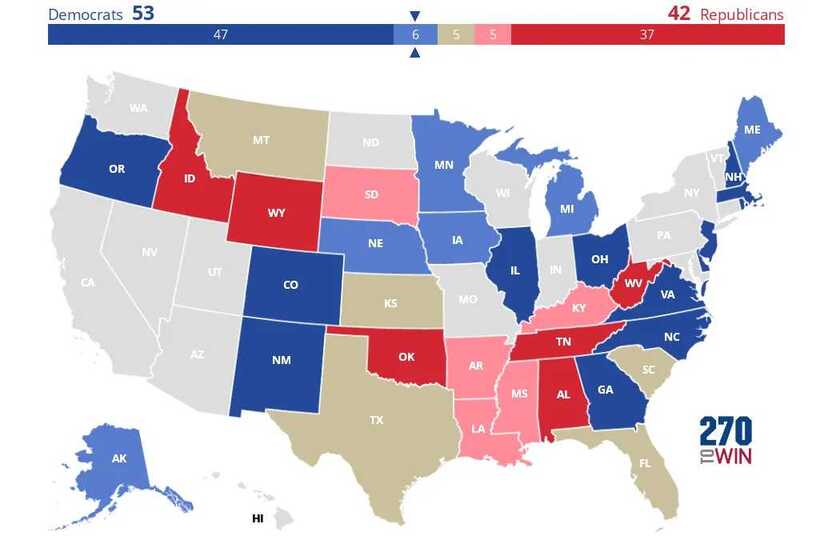
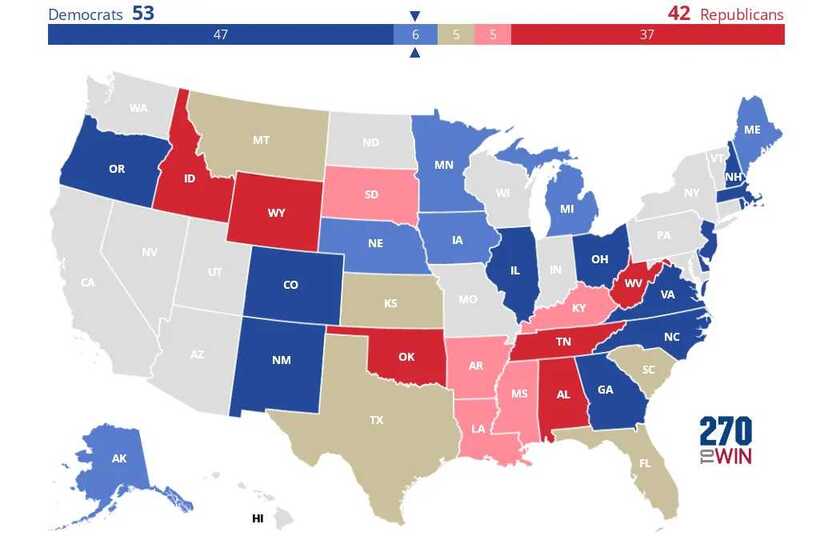
In big swing election cycles, even “safe” Senate seats can suddenly turn razor close, as Bob Dole found out in 1974, barely holding on to his Kansas seat before being the VP nominee two years later. Strong independent candidates in Kansas, Nebraska, South Dakota and Montana may pose a unique threat to GOP held seats, as the Nebraska race in 2024 showed, with Osborn running 17 points ahead of Harris’ margin in the state. Democrats field the much better candidate in Ohio with a proven track record of out-performing Democratic margins in the state, while the Texas GOP nominee faces abandonment from his own party after they spent over $100M bashing him in the state for a disliked party incumbent. Alaska primary results suggest the Democratic nominee already holds the edge in that ranked choice voting state, while the famed cross-over support for Collins in Maine appears to be fading with newer generations taking over the voter rolls. My current map would be as follows, with surprising closer-than-expected races in Montana, Kansas, Louisiana, Florida, Mississippi, South Dakota, South Carolina and Kentucky, and a median map of Democrats holding 53+ Senate seats after the 2026 elections.


If past is prologue, the map won’t save the GOP in 2026, and an ever bigger tsunami may be incoming than anyone in Washington expects.

Read full Article
post photo preview
OFFICIAL PICKS: Midterms, 2026
House Elections Projections
 
The House tends to be more responsive to midterm dynamics, but, like the Senate, swings hard in elections where some combination of the Four Factors are present -- cost of living crisis or recession; war; major scandal; betrayal or down-ballot realignment. A fun map to use is this simulator, which takes partisan averages from existing models, and plugs in the map based on your adjustment of the generic ballot edge for one party or another. https://globalelectionsimulator.com/#/usa-house
 
Historic Norms: When a combination of the Four Factors are present, this is the kind of swing you get:
1930: 52 seat swing
1946: 55 seat swing
1958: 49 seat swing
1974: 49 seat swing
1994: 54 seat swing
2006: 31 seat swing
 
2026 PROJECTIONS


Only for Supporters
To read the rest of this article and access other paid content, you must be a supporter
Read full Article
post photo preview
Barnes Betting Report: Senate 2026

First, four factors dictate whether there is major turnover in the Senate in a midterm election independent of the favorability of the Senate map (due to only one-third of seats being up in any given midterm). Often, as was the case in both 2018 and 2022, is that incumbents are not destined to lose seats, outside of realigning elections in unfavorable maps. This cycle's map favors the GOP, which is why the prediction markets and most forecasters expect a GOP majority in the 2027 Senate. The four factors that prove dangerous to the incumbent party are: first, a recession or cost of living crisis; second, a war; third, a major scandal; and fourth, a sense of betrayal in the voter group that backed the incumbent amongst some portion of their prior electoral coalition. Five midterms feature some combingation of those factors in some significant degree: 1930, 1946, 1958, 1974 and 2006.

Without those factors present in multiple forms, the incumbent party can expect to hold on to seats in states it previously won outside the national margin. When those factors are present, the landscape shifts dramatically. Examining those White House incumbent seats that showed a state-wide election decided by single digits in the prior decade produces the following probabilities: the incumbent White House party lost at least 67% of its incumbent held seats, as much as 85% of its incumbent held seats, and an average of 75% of its incumbent hold seats, rarely upsetting the opposition party in any seat and often losing a surprise or two in seats considered completely safe. 


Only for Supporters
To read the rest of this article and access other paid content, you must be a supporter
Read full Article
See More
Available on mobile and TV devices
google store google store app store app store
google store google store app tv store app tv store amazon store amazon store roku store roku store
Powered by Locals