SportsPicks
Politics • Investing & Finance • Sports
Thoughts on Last Night
November 05, 2025
post photo preview

Around around she goes; we she ends, nobody knows. Only truly beatable infinity, unless you believe in luck So The Good Thief lead character explains as he sees the ball chase around the roulette wheel. But it wasn't luck that lost me last night; it was failing to follow my own methodologies for the best decision making in the world of prediction markets.  

Many of my assumptions held (Mamdani bets cashed to a profit, the Democratic sweep happened, and Morris County flipped to Sherrill, while closest race was the Virginia Attorney General), but a big one didn't -- that 2025 would not bring a record-setting Democratic wave. The wave crested like a tsunami, felt coast to coast, from the northeast to the southwest, from the midatlantic to the mountains, from the industrial midwest to the southern countryside, effecting small town mayoral races in Pennsylvania to Public Service Commission statewide gigs in Georgia, from legislative districts with 36 year incumbents in ruby red Virginia heartland to the most revolutionary Mayor ever elected in New York City since Henry George's failed effort signaled the rise of Populism a century+ ago. Candidate quality did not matter. Candidate spending did not matter. Incumbency did not matter. Job approval did not matter. Scandals did not matter enough or did not matter at all. Get out the vote efforts did not matter. This was an angry electorate seeking vengance, and finding its expression wherever they could. 

That was my first mistake, and it was a mistake, rather than bad luck. I assessed the wave risk at 10%, when it was manifestly much higher. All I needed to do was listen to....myself. I went back and watched my last episode w/ Baris and an episode a few months ago with the Duran, the latter where I previewed a collapse in GOP support if Trump didn't escape the foreign focus & wars, delivering only to the donor class. I spoke often of the new MAGA that began to build in 2023 -- young, working class, often minority, deeply unhappy with the political direction of an elder class they are rebelling against, as easily tempted by left populism as right populism, and as easily susceptible to political apathy and agnosticism as engagement & activism. The shutdown was actually a negative tipping factor for these voters, as the SNAP issue played poorly with them, while enraging part of the Democratic base otherwise unenthused up to that point. I made two errors in methodology & one error in psychology I detail below. 

The second error was bankroll percentage. It was a single race in a single state; as such, keeping it closer to 5% made more sense than expending it to 34%, especially if more cognizant of the risk. It also shifted my stronger risk appetite onto others, and that was en error I usually well avoid. If I had listed every major election pick this year at 5%, we'd be in the black; even last night, splitting 5% bets amidst the 3 elections, would have only been a modest loss, given certain underdog bets hit with Mamdani. As I often say, but forgot here to practice -- bankroll discipline is the most important aspect of successful trading in the markets, sports or politics. 

The psychological error was getting attached to a pick, and not relooking at it from scratch anytime new information arives. A natural tendency is to stay committed to something merely because of prior committment rather than look at it completely anew, and being afraid of taking a loss when once vested in so much hope of a win. 

Areas to improve:

  • using the methodological approach of motivated reasoning -- you cannot make reason the master of motivation, but you can use motivation to master reasoning. The Elephant in the Brain. I needed to put myself in a position to take the opposite side of each pick, make the best argument possible for it, and then test it against the other side. In this respect, one way to best maximize this is to include substack-style articles on this site laying out the argument, and letting the community respond -- as several sagely warned in this case, which can dramatically improve the quality of reasoning;
  • tracking all data available -- for example, whether an off-year election could be a wave election that might have polls actually overstate the White House incumbent party that even the GOP the polls tend to be biased against & digger deep dives into possible explanation for a poll's results (for examply, Miyares surge was partly fog, by Democratic voters choosing undecided rather than voting against b/c they didn't want to admit they secretly supported the murderous texts of their Attorney General candidate; 
  • waiting until election eve and election day, especially in the US elections, as the volatility proffers the best opportunities, and the best information is then availabile if timely processed; 
  • finding a way to better track live-time data on election night by reemploying an older technique from my political campaign days -- prior to the election, predicting the expected % for each county (and key precincts when available) in terms of expected vote share & vote distribution, which can most accurately forecast where an election will go, to get ahead of the markets (the big models out there completely crashed last night, including the $250K new-and-improved Decision Desk model;
  • avoiding all bubbles & returning to getting into the head of a wide range of voting groups, something I long excelled in, but have to dedicate myself to these days due to inhabiting a political world more these days that can make me too responsive to criticism -- "hey Barnes, you're a panican; hey Barnes, your Barnes/Baris voter is mythical; you don't get it, Jack is a lock in New Jersey". I need to step into the minds of these independent voters, and keep listening to the independent podcasters who were a useful signal in 2024 and 2025 -- see how Andrew Stein, Tim Dhillon, Joe Rogan, Dave Smith, Theo Von -- all left Trump train in the summer of 2025;
  • staying within the 5% max recommendation on a single election in a single state unless extraordinary reason supported by extraordinary evidence recommends otherwise, and including the assumptions in those extraordinary picks such that the pick can be sold off quick if those assumptions show other signs in the data

Truth is, losses teach you more than wins. Despite as much as I try to track the underlying assumptions of winning picks, the stay-up-top-3-am reearching and obsessing motivation comes from tough losses. In addition, I learn the values of patience, forbearance, discipline, emotional equilibrium, self-belief, as well as better improving a sound methodological approach through "putting my money where mouth is" and sharing it with the world for public accountability and transparency improving decision-making skill over time, maintaining humility when the trap of hubris would otherwise ensnare.

After three decades of successful US elections, my setback in 2022 dramatically improved my analysis for 2024, proving fantastically profitable. Thanks to everyone for participating, hope you continue to partake in the community, and if I were a betting man, and I am, I would wager we will be profitable again, in matters of pocketbook, principle and politics very soon. 

community logo
Join the SportsPicks Community
To read more articles like this, sign up and join my community today
14
What else you may like…
Videos
Podcasts
Posts
Articles
Barnes Brothers: European Soccer MEGA Preview
01:08:49
Barnes Brothers: World Cup Final Preview
00:46:09
World Cup Final Preview: Barnes Brothers

Enjoy before the big finale on Sunday.

00:46:09
SEC Preview Podcast

A full breakdown of every team in the SEC, including talent analysis, coordinator concern, and schedule forecasts, with win total expectations. Enjoy!

SEC Preview Podcast
Smokehouse Mike's NCAAB

March Madness final four recap and Championship preview...

Smokehouse Mike's NCAAB
Smokehouse Mike's NBA
LIVE CHAT FOR 2026

Now open!

Crick's Picks: College Football - 9/3/26

You & Your Beautiful Families STAY SAFE Out There!!! Good Luck & Good Gamblin!!!!

ATS = Against The Spread

ML = Money Line

ALT = Alternate Spreads

TT = Team Total

SGP = Same Game Parlay

1Q, 2Q, etc. = Bet Is Only For That Individual Quarter

1H & 2H = Bet Is Only For That Individual Half

1/2-Unit = 50% Unit (.5 Units)

1/4-Unit = 25% Unit (.25 Units)

SPRINKLE = At Your Discretion (DON'T GO CRAZY!!!!)

THESE ARE NOT SPORTSPICKS "OFFICIAL PICKS"

ALL MY ODDS COME FROM DRAFTKINGS

Crick's Picks Results: Week 0/YTD

Week 0

  • 1-1 ATS -1.22 Units

0-1 (3-Unit Plays)

1-0 (2-Unit Plays)

  • 0-2 ALT -2.00 Units

0-2 (1-Unit Plays)

College Football: Week 0 - Overall = -3.22 Units

Year To Date

  • 1-1 ATS -1.22 Units

0-1 (3-Unit Plays)

1-0 (2-Unit Plays)

  • 0-2 ALT -2.00 Units

0-2 (1-Unit Plays)

**College Football: Year To Date...

post photo preview

🔥 September 3, 2026 Degenerate Special 🔥

4-1 on the main ticket.

1. 4-Leg Main (SGP+) — Odds: -137
• Logan Henderson 4+ Strikeouts — MIL Brewers @ CHC Cubs 7:15 PM ET
• Kevin Gausman 4+ Strikeouts — MIL @ CHC (Same Game)
• Hunter Brown 5+ Strikeouts (-530) — CWS White Sox @ HOU Astros 2:10 PM ET
• Tarik Skubal 6+ Strikeouts (-1000) — STL Cardinals @ LAD Dodgers 10:10 PM ET

Main first. Protected lines. Let’s ride.

#MLBProps #StrikeoutProps #KProps #DegenerateMode

post photo preview
Forecasting the Senate in 2026

Two conflicting trends dictate the Senate outcome in 2026. The map heavily favors Republicans, as the competitive Senate seats up lean heavily Republican. By contrast, the election context heavily favors Democrats, with war, recession, realignment and scandal tipping in their direction. A deeper dive reveals why prediction markets still likely undersell Democratic prospects.

First, the idea that Senate midterms favor the party out of power in the White House is belied by both recent and a century of history of Senate elections. Unlike the House, only a third of Senate seats face election in any midterm, and that map dictates outcomes unless the election context is particularly bad for the incumbent party.

Consider that the highly unpopular Biden didn’t lost any net Senate seats in 2022 and Trump added Senate seats in the Democratic friendly cycle in 2018. Equally, Clinton didn’t lose net Senate seats in 1998 nor did W. in 2002. Even low-approval election cycles like 1966 and 1982 didn’t produce a big swing in the Senate. Indeed, since 1934, the party in power only lost 10% or more of their Senate seats (4+) less than half of the time. Democrats need a flip of exactly that — at least 4 Senate seats — to retake power in the Senate.

Then take a look at the map, and you can see the reason for optimism in GOP circles and some traders in the prediction markets. Only 2 GOP-held seats are in states Trump won by less than double digits, while 2 Democratic-held seats are in states Trump won, and one of those GOP held seats features a long-time incumbent who typically runs double-digits ahead of the GOP norm (Collins in Maine). This is why the GOP entered the year believing odds of losing the Senate were remote, and the prediction markets mostly concurred.

But this ignores the counter-trend: the degree of election dismay with the incumbent party in the White House, and the reasons for that dismay. Presidential job approval has not been a neat proxy for Senate midterms because it depends on the reason for that dissatisfaction in the electorate. Four factors drive Senatorial midterms: war, recession/cost of living, realignment, and scandal. When two of those four factors are not present and don’t dominate, then the incumbent party’s odds of losing 4+ Senate seats drops to less than 20%. By contrast, when two of those four factors are present and do predominate, then the odds of the incumbent party losing 4+ Senate seats rises to 100%. Indeed, the median number of Senate seats lost when some combination of war, recession, realignment and scandal, are present, the White House party loses at least 8 Senate seats.

A few examples: while FDR added Senate seats in 1934 midterms, he lost 9 in 1938 midterms due to the combination of recession and scandal (trying to stack SCOTUS). 1942 and 1946 gave us war and recession to cost Democrats 8 and 12 Senate seats alike. 1950 gave us war again and scandals concerning the war costing Democrats 5 Senate seats. 1958 gave us recession and scandal, costing Ike 15 Senate seats. While JFK added Senate seats in 1962 and Nixon added Senate seats in 1970, only Watergate and stagflation in 1974 or the combination of Iran Contra and vulnerable class of 1980 incumbents cost the incumbent party 4 or more Senate seats until the realignment election of 1994, where evangelicals shifted their down-ballot voting to the GOP en masse. It took war and scandal in 2006 to see the Senate switch 4+ Senate seats again.

That’s the story of 2026: a very GOP favorable Senate map versus a very Democratic friendly election cycle. The GOP enters election season with all four factor present: war, recession/cost of living, realignment, and scandal. The Iran War was already deeply unpopular, and it’s impact on the economy in gas and diesel prices turns Americans sour on their current economic prospects, as wages fall behind, housing and health care feel increasingly unaffordable, labor force participation continues to drop, the the mirage of AI keeps the GDP just above a technical recession. The Epstein scandal remains one of the worst scandals in American political history, and Trump managed to associate himself deeply with the scandal in his handling of it. Then the realignment, as the new Trump 2024 voters joined the Obama-Trump converts of 2016 in abandoning GOP identity, already evident in surveys and primary participation.

A quintet of voter groups appear to be realigning away from the Republican brand — hispanic voters, black voters, industrial area voters, libertarian-leaning voters, and war-skeptical voters alike. This realigning electorate shows up disproportionately in key Senate contests. The war-skeptical voters in states like Maine, New Hampshire, Ohio, Michigan, Iowa, Montana, Nebraska, and Alaska (these are the states W failed to gain in between 2000 and 2004 due to the Iraq War before it even turned unpopular). The hispanic voters in states like Florida and Texas. The African-American voters in states like North Carolina and Georgia. The industrial voters in Ohio and Michigan. The libertarian leaving voters in states like New Hampshire, Alaska, Texas and Florida.

Thus, many of the states that seem “Safe” on the map are anything but, as their realigning electorates shift back against the Republican brand, with all of them having recent histories in electoral cycles of favoring Democrats or being true swing states. Take states like Florida and Texas where suburban margins began to erode for the GOP in the Trump era but countered that by massive margin shifts in hispanic and black precincts. Primary participation, voter identification, and public opinion surveys show those black and hispanic voters shifting back massively away from the GOP brand, which, given the erosion in some suburban areas and losses with younger generations, makes states Florida and Texas closer to competitive than double-digit leans.

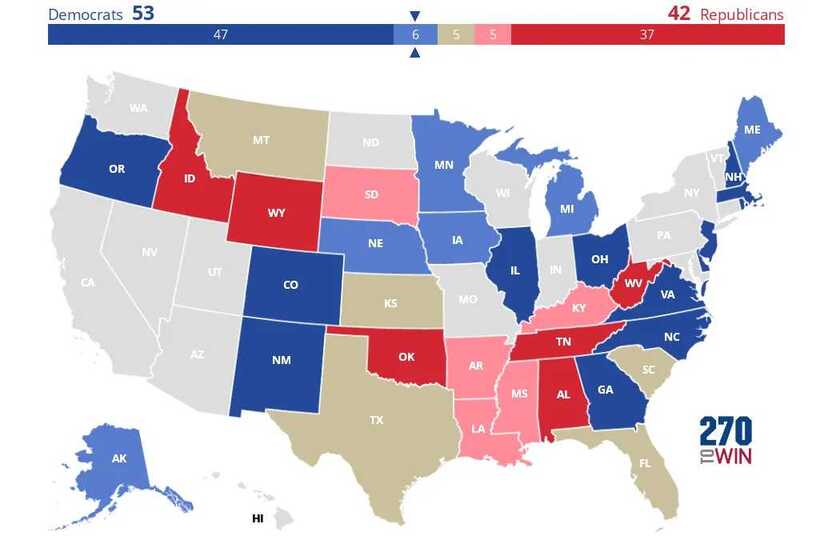
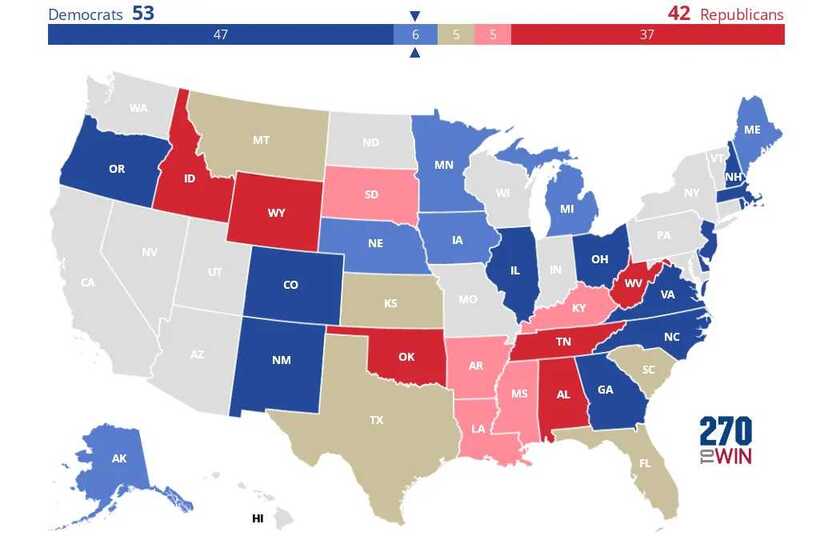
In big swing election cycles, even “safe” Senate seats can suddenly turn razor close, as Bob Dole found out in 1974, barely holding on to his Kansas seat before being the VP nominee two years later. Strong independent candidates in Kansas, Nebraska, South Dakota and Montana may pose a unique threat to GOP held seats, as the Nebraska race in 2024 showed, with Osborn running 17 points ahead of Harris’ margin in the state. Democrats field the much better candidate in Ohio with a proven track record of out-performing Democratic margins in the state, while the Texas GOP nominee faces abandonment from his own party after they spent over $100M bashing him in the state for a disliked party incumbent. Alaska primary results suggest the Democratic nominee already holds the edge in that ranked choice voting state, while the famed cross-over support for Collins in Maine appears to be fading with newer generations taking over the voter rolls. My current map would be as follows, with surprising closer-than-expected races in Montana, Kansas, Louisiana, Florida, Mississippi, South Dakota, South Carolina and Kentucky, and a median map of Democrats holding 53+ Senate seats after the 2026 elections.


If past is prologue, the map won’t save the GOP in 2026, and an ever bigger tsunami may be incoming than anyone in Washington expects.

Read full Article
post photo preview
OFFICIAL PICKS: Midterms, 2026
House Elections Projections
 
The House tends to be more responsive to midterm dynamics, but, like the Senate, swings hard in elections where some combination of the Four Factors are present -- cost of living crisis or recession; war; major scandal; betrayal or down-ballot realignment. A fun map to use is this simulator, which takes partisan averages from existing models, and plugs in the map based on your adjustment of the generic ballot edge for one party or another. https://globalelectionsimulator.com/#/usa-house
 
Historic Norms: When a combination of the Four Factors are present, this is the kind of swing you get:
1930: 52 seat swing
1946: 55 seat swing
1958: 49 seat swing
1974: 49 seat swing
1994: 54 seat swing
2006: 31 seat swing
 
2026 PROJECTIONS


Only for Supporters
To read the rest of this article and access other paid content, you must be a supporter
Read full Article
post photo preview
Barnes Betting Report: Senate 2026

First, four factors dictate whether there is major turnover in the Senate in a midterm election independent of the favorability of the Senate map (due to only one-third of seats being up in any given midterm). Often, as was the case in both 2018 and 2022, is that incumbents are not destined to lose seats, outside of realigning elections in unfavorable maps. This cycle's map favors the GOP, which is why the prediction markets and most forecasters expect a GOP majority in the 2027 Senate. The four factors that prove dangerous to the incumbent party are: first, a recession or cost of living crisis; second, a war; third, a major scandal; and fourth, a sense of betrayal in the voter group that backed the incumbent amongst some portion of their prior electoral coalition. Five midterms feature some combingation of those factors in some significant degree: 1930, 1946, 1958, 1974 and 2006.

Without those factors present in multiple forms, the incumbent party can expect to hold on to seats in states it previously won outside the national margin. When those factors are present, the landscape shifts dramatically. Examining those White House incumbent seats that showed a state-wide election decided by single digits in the prior decade produces the following probabilities: the incumbent White House party lost at least 67% of its incumbent held seats, as much as 85% of its incumbent held seats, and an average of 75% of its incumbent hold seats, rarely upsetting the opposition party in any seat and often losing a surprise or two in seats considered completely safe. 


Only for Supporters
To read the rest of this article and access other paid content, you must be a supporter
Read full Article
See More
Available on mobile and TV devices
google store google store app store app store
google store google store app tv store app tv store amazon store amazon store roku store roku store
Powered by Locals