



Recap: The bad beats of all bad beats -- or the biggest break for the luckiest of gamblers -- finished off the first round of the NCAA tourney, as a rolling ball with less than a second left from out of bounds somehow ended up in a near mid-court 3 pointer to give TCU the late-as-possible backdoor cover. The best game of the day though was a battle of kitty cats in Kentucky versus Kansas State as Kansas State took down mighty Kentucky once again as a tourney underdog in a tight to-the-wire finish. This tourney may turn out the most profitable for bookies in decades, as the public favorites on Sunday -- Kentucky & Indiana -- both fell. Bookies were toasting all weekend to the sorrows of their gamblers, but not sportsPicks subscribers who, thanks to First Four picks, Live chat picks, and a big, big 5% win on Friday, are still in the black heading into the second leg of the tourney for the second straight year.
Preview: We will put up a full Sweet 16 preview tomorrow. Early Vegas leans show the public favoring the favorites in this round, with the public leaning almost all chalk so far in the early action, with only one dog getting love -- Miami, the team the public bet heavily against in the first 2 rounds. From a seeding perspective by historic tourney performance, the over-rated teams are Michigan State, Tennessee, Texas, San Diego State, and UConn, with 4 of those five public favorites as well. A little trivia: 8 and 9 seeds have a winning record in the Sweet 16 against higher seeds.
Last, but not least: remember you can message me here at SportsPicks, and get helpful, useful tips like this I gave pre-tourney to a bettor thinking about taking Duke and Virginia to make a run.
My pre-tourney advice:
"Duke. Rookie coach. Not a top-20 offense (not even in top 40). No elite scorers (10+ points/58% true shooting). Only 1 good 3-point shooter (38%+). An atrocious record away from home against tourney-type top 100 teams: 3-8 straight up. Recipe for early exit.
Virginia. Underperforming coach in tourney. Not a top-20 offense (not even in top 60). No elite scorers. Only 1 good 3-point shooter (38%+). Average record away from home against tourney-type top 100 teams: 4-4. Unlikely to make a deep run."
Honor the Madness.
UFC OKC Sherdog prelim picks
https://www.sherdog.com/news/articles/1/Preview-UFC-Oklahoma-City-prelims-201915
World Cup Semi Finals England vs Argentina - My Picks
0.5% Over 2.5 goals at 39c (good to 44c)
0.5% Both teams to score at 52c (good to 56c)
(Optional) 0.5% Game to go to penalties at 19c (good to 22c)
The second semi final will begin shortly between England and Argentina. This will be a fiery semi final as the two countries have a historical football rivalry going back to the 1980s when Diego Maradona scored his infamous "Hand of God" goal before going an mazy run to score one of the all time World Cup goals. It was a tense matchup even back then due to the military conflict between England and Argentina. This conflict may go back to before many fans were born but there is certainly no love lost between these teams when it comes to football.
England made it to the semi final with an athletic, transition based system under Thomas Tuchel. This has been effective against opponents who play more openly, such as Croatia and Mexico while struggling more against opponents who are able to ...
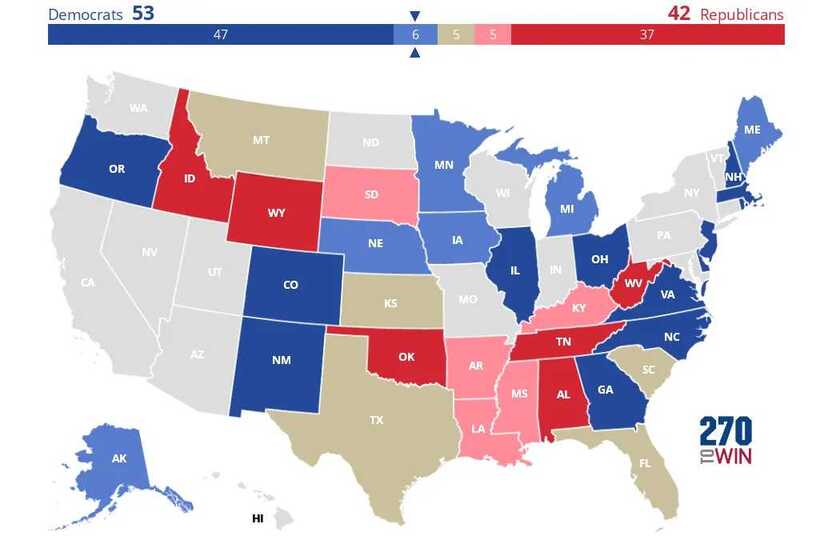
First, four factors dictate whether there is major turnover in the Senate in a midterm election independent of the favorability of the Senate map (due to only one-third of seats being up in any given midterm). Often, as was the case in both 2018 and 2022, is that incumbents are not destined to lose seats, outside of realigning elections in unfavorable maps. This cycle's map favors the GOP, which is why the prediction markets and most forecasters expect a GOP majority in the 2027 Senate. The four factors that prove dangerous to the incumbent party are: first, a recession or cost of living crisis; second, a war; third, a major scandal; and fourth, a sense of betrayal in the voter group that backed the incumbent amongst some portion of their prior electoral coalition. Five midterms feature some combingation of those factors in some significant degree: 1930, 1946, 1958, 1974 and 2006.
Without those factors present in multiple forms, the incumbent party can expect to hold on to seats in states it previously won outside the national margin. When those factors are present, the landscape shifts dramatically. Examining those White House incumbent seats that showed a state-wide election decided by single digits in the prior decade produces the following probabilities: the incumbent White House party lost at least 67% of its incumbent held seats, as much as 85% of its incumbent held seats, and an average of 75% of its incumbent hold seats, rarely upsetting the opposition party in any seat and often losing a surprise or two in seats considered completely safe.