These are not Sportspicks "Recommended Picks"
What's Up Y'all!?!? The 2023 NFL Draft is FINALLY here, and that just means we're one step closer to the MOST wonderful time of the year... FOOTBALL SEASON!!!! There are TONS of different ways to bet the Draft... You can bet on: The exact pick a player will be taken, O/U's on where a certain player will be taken, position of the player taken first by a certain team, and much MUCH MORE!! In this post, I'll give you guy's: MY Picks for each Top 10 Pick and the odds for that player to go in THAT spot in the Draft. Also, I'll Provide some other props I like for Tonight.. PLEASE NOTE... This is more for FUN than anything... I DO NOT Recommend any more than 20% of your normal "Unit Bet" on ANY of these picks!! Just wanted to be CLEAR on that.. With ALL the moving variables that go into the NFL Draft with trading picks and all that.. It's tough to gain a REAL edge from a gambling perspective, in my opinion.. However, there are some GEMS out there if you're willing to REALLY dive in and do the RESEARCH for this thing!! It can be A LOT of fun, and really pay out nicely if you're able to locate some of those "Diamonds in the Rough"!! Hope you guy's ENJOY it this evening!! As ALWAYS... Stay SAFE, Good Luck, and Good Gamblin!!!!
Crick's Picks: NFL Draft
Top 10 Picks
1.) Carolina Panthers - QB Bryce Young -5000
2.) Houston Texans - DE/LB Will Anderson Jr. -330
3.) Tennessee Titans - QB CJ Stroud -140
Rumors are that the Titans are working on a trade with the Arizona Cardinals for the 3rd Overall Pick
4.) Indianapolis Colts - QB Will Levis +125
5.) Seattle Seahawks - DL Jalen Carter -300
6.) Detroit Lions - DB Devon Witherspoon -210
7.) Las Vegas Raiders - QB Anthony Richardson +800
8.) Atlanta Falcons - DE Tyree Wilson +650
9.) Chicago Bears - OL Paris Johnson Jr. +350
10.) Philadelphia Eagles - RB Bijan Robinson +550
Draft Position (O/U's Pick Taken)
For Example: I believe Richardson will NOT be taken in the Top 4 Picks
QB Hendon Hooker UNDER 31.5 -110
DB Joey Porter Jr. UNDER 19.5 +175
RB Bijan Robinson UNDER 10.5 +125
TE Michael Mayer UNDER 21.5 +100
OL Peter Skoronski OVER 10.5 -140
Position Totals For 1st Round
Total QB's Drafted in 1st Round OVER 4.5 -110
Total Defensive Players Drafted in 1st Round OVER 14.5 +240
Which Player will be Drafted First
RB Bijan Robinson +110 vs OL Peter Skoronski
OL Darnell Wright +150 vs WR Jaxon Smith-Njigba
Mr. Irrelevant
Position Props
CJ Stroud to be 2nd QB Selected in Draft -250
Will Levis to be 3rd QB Selected in Draft +140
Quentin Johnson to be 1st WR Selected in Draft +800
Zay Flowers to be 2nd WR Selected in Draft -120
Dalton Kincaid to be 1st TE Selected in Draft +150
Team Draft Props
New England Patriots to Draft a CB with 1st Selection +250
New York Jets to Draft a TE with 1st Selection +1000
Pittsburgh Steelers to Draft a DL/EDGE with 1st Selection +450
Baltimore Ravens to Draft a WR with 1st Selection +200
Jacksonville Jaguars to Draft an OL with 1st Selection +125
Las Vegas Raiders to Draft a QB with 1st Selection +270
Los Angeles Chargers to Draft a TE with 1st Selection +250
Kansas City Chiefs to Draft a WR with 1st Selection +150
Philadelphia Eagles to Draft a RB with 1st Selection +300
Green Bay Packers to Draft DL/EDGE with 1st Selection +225
Tampa Bay Buccaneers to Draft a LB with 1st Selection +400
Atlanta Falcons to Draft a DL/EDGE with 1st Selection -115
Team to Draft Player
Las Vegas Raiders to Draft QB Anthony Richardson +1200
Philadelphia Eagles to Draft RB Bijan Robinson +300
Seattle Seahawks to Draft QB Hendon Hooker +700
Buffalo Bills to Draft Jahmyr Gibbs +1000
New York Jets to Draft Jaxon Smith-Njigba +450
Los Angeles Chargers to Draft Michael Mayer +650
Houston Texans to Draft Quentin Johnson +1200
Pre-Season Awards
Jahmyr Gibbs To Win Offensive Rookie of the Year +1100
Devon Witherspoon To Win Defensive Rookie of the Year +900
Aaron Rodgers To Win MVP +1800
Ahmad Gardner To Win Defensive Player of the Year +1400
Calvin Ridley Comeback Player of the Year +2500
Demeco Ryans To Win Coach of the Year +2000
Enjoy the Draft!! We're that much CLOSER to KICKOFF!!
Good Luck and Good Gambling!!!!
-Crickett

In this edition of "Master Class", we're gonna look at Prediction Markets vs Sportsbooks, and why the Prediction Markets are the Future of Sports Betting!! Come join us, as we try to provide you with all the tools to STACK YOUR NICKELS TO THE CEILING!! Feel Free to drop any questions you have in the comments!! Hope This Helps My Friends!! Good Luck, Good Gamblin, & Have The Day You Deserve!!
-Crickett
I SUCK AT THE NFL SO TREAD LIGHTLY!!!!!!
You & Your Beautiful Families STAY SAFE Out There!!! Good Luck & Good Gamblin!!!!
ATS = Against The Spread
ALT = Alternate Spreads
ML = Money Line
GP = Game Props
O/U = Over/Under
TT = Team Total
IPP = Individual Player Props
ATTD = Anytime Touchdown Scorer
SGP = Same Game Parlay
1Q, 2Q, etc. = Bet Is Only For That Designated Quarter
1H or 2H = Bet Is Only For That Designated Half
1/4-Unit = 25% (.25 Units)
1/2-Unit = 50% (.5 Units)
ALL MY ODDS COME FROM DRAFTKINGS
THESE ARE NOT SPORTSPICKS "OFFICIAL PICKS"
Crick's Picks Results: NFL - Week1 /YTD
Week 1
2-3 (2-Unit Plays)
0-1 (2-Unit Plays)
1-1 (1-Unit Plays)
1-2 (1-Unit Plays)
**Kyler Murray (Vikings) Exited the Game in the 1st Quarter Due To Injury. Therefore, All Prop Bets On Him Were Refunded Due To ...
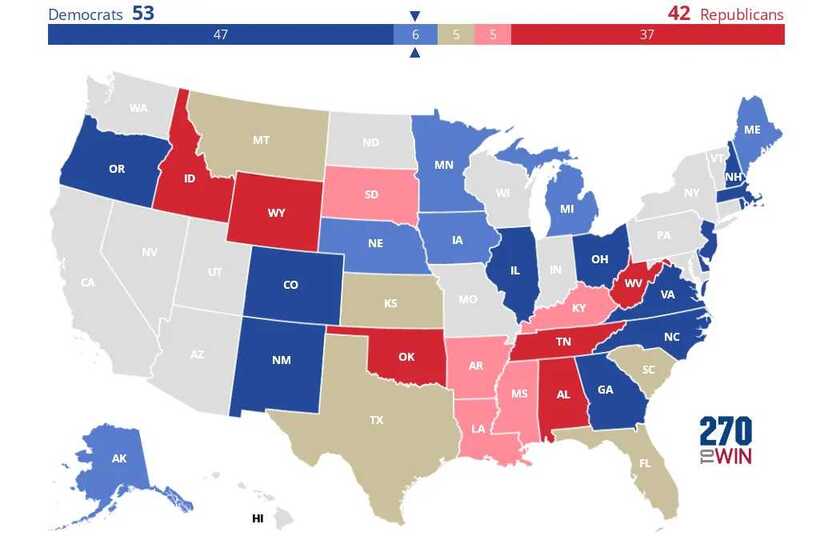
Two conflicting trends dictate the Senate outcome in 2026. The map heavily favors Republicans, as the competitive Senate seats up lean heavily Republican. By contrast, the election context heavily favors Democrats, with war, recession, realignment and scandal tipping in their direction. A deeper dive reveals why prediction markets still likely undersell Democratic prospects.
First, the idea that Senate midterms favor the party out of power in the White House is belied by both recent and a century of history of Senate elections. Unlike the House, only a third of Senate seats face election in any midterm, and that map dictates outcomes unless the election context is particularly bad for the incumbent party.
Consider that the highly unpopular Biden didn’t lost any net Senate seats in 2022 and Trump added Senate seats in the Democratic friendly cycle in 2018. Equally, Clinton didn’t lose net Senate seats in 1998 nor did W. in 2002. Even low-approval election cycles like 1966 and 1982 didn’t produce a big swing in the Senate. Indeed, since 1934, the party in power only lost 10% or more of their Senate seats (4+) less than half of the time. Democrats need a flip of exactly that — at least 4 Senate seats — to retake power in the Senate.
Then take a look at the map, and you can see the reason for optimism in GOP circles and some traders in the prediction markets. Only 2 GOP-held seats are in states Trump won by less than double digits, while 2 Democratic-held seats are in states Trump won, and one of those GOP held seats features a long-time incumbent who typically runs double-digits ahead of the GOP norm (Collins in Maine). This is why the GOP entered the year believing odds of losing the Senate were remote, and the prediction markets mostly concurred.
But this ignores the counter-trend: the degree of election dismay with the incumbent party in the White House, and the reasons for that dismay. Presidential job approval has not been a neat proxy for Senate midterms because it depends on the reason for that dissatisfaction in the electorate. Four factors drive Senatorial midterms: war, recession/cost of living, realignment, and scandal. When two of those four factors are not present and don’t dominate, then the incumbent party’s odds of losing 4+ Senate seats drops to less than 20%. By contrast, when two of those four factors are present and do predominate, then the odds of the incumbent party losing 4+ Senate seats rises to 100%. Indeed, the median number of Senate seats lost when some combination of war, recession, realignment and scandal, are present, the White House party loses at least 8 Senate seats.
A few examples: while FDR added Senate seats in 1934 midterms, he lost 9 in 1938 midterms due to the combination of recession and scandal (trying to stack SCOTUS). 1942 and 1946 gave us war and recession to cost Democrats 8 and 12 Senate seats alike. 1950 gave us war again and scandals concerning the war costing Democrats 5 Senate seats. 1958 gave us recession and scandal, costing Ike 15 Senate seats. While JFK added Senate seats in 1962 and Nixon added Senate seats in 1970, only Watergate and stagflation in 1974 or the combination of Iran Contra and vulnerable class of 1980 incumbents cost the incumbent party 4 or more Senate seats until the realignment election of 1994, where evangelicals shifted their down-ballot voting to the GOP en masse. It took war and scandal in 2006 to see the Senate switch 4+ Senate seats again.
That’s the story of 2026: a very GOP favorable Senate map versus a very Democratic friendly election cycle. The GOP enters election season with all four factor present: war, recession/cost of living, realignment, and scandal. The Iran War was already deeply unpopular, and it’s impact on the economy in gas and diesel prices turns Americans sour on their current economic prospects, as wages fall behind, housing and health care feel increasingly unaffordable, labor force participation continues to drop, the the mirage of AI keeps the GDP just above a technical recession. The Epstein scandal remains one of the worst scandals in American political history, and Trump managed to associate himself deeply with the scandal in his handling of it. Then the realignment, as the new Trump 2024 voters joined the Obama-Trump converts of 2016 in abandoning GOP identity, already evident in surveys and primary participation.
A quintet of voter groups appear to be realigning away from the Republican brand — hispanic voters, black voters, industrial area voters, libertarian-leaning voters, and war-skeptical voters alike. This realigning electorate shows up disproportionately in key Senate contests. The war-skeptical voters in states like Maine, New Hampshire, Ohio, Michigan, Iowa, Montana, Nebraska, and Alaska (these are the states W failed to gain in between 2000 and 2004 due to the Iraq War before it even turned unpopular). The hispanic voters in states like Florida and Texas. The African-American voters in states like North Carolina and Georgia. The industrial voters in Ohio and Michigan. The libertarian leaving voters in states like New Hampshire, Alaska, Texas and Florida.
Thus, many of the states that seem “Safe” on the map are anything but, as their realigning electorates shift back against the Republican brand, with all of them having recent histories in electoral cycles of favoring Democrats or being true swing states. Take states like Florida and Texas where suburban margins began to erode for the GOP in the Trump era but countered that by massive margin shifts in hispanic and black precincts. Primary participation, voter identification, and public opinion surveys show those black and hispanic voters shifting back massively away from the GOP brand, which, given the erosion in some suburban areas and losses with younger generations, makes states Florida and Texas closer to competitive than double-digit leans.
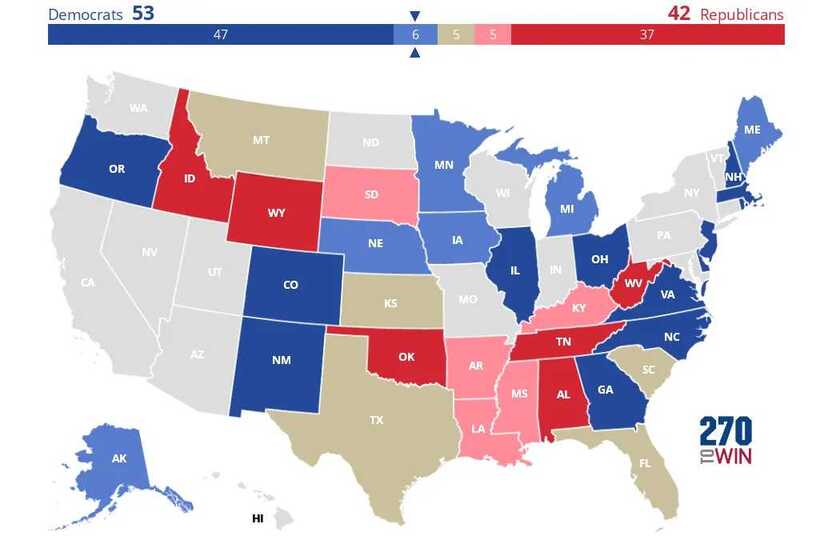
In big swing election cycles, even “safe” Senate seats can suddenly turn razor close, as Bob Dole found out in 1974, barely holding on to his Kansas seat before being the VP nominee two years later. Strong independent candidates in Kansas, Nebraska, South Dakota and Montana may pose a unique threat to GOP held seats, as the Nebraska race in 2024 showed, with Osborn running 17 points ahead of Harris’ margin in the state. Democrats field the much better candidate in Ohio with a proven track record of out-performing Democratic margins in the state, while the Texas GOP nominee faces abandonment from his own party after they spent over $100M bashing him in the state for a disliked party incumbent. Alaska primary results suggest the Democratic nominee already holds the edge in that ranked choice voting state, while the famed cross-over support for Collins in Maine appears to be fading with newer generations taking over the voter rolls. My current map would be as follows, with surprising closer-than-expected races in Montana, Kansas, Louisiana, Florida, Mississippi, South Dakota, South Carolina and Kentucky, and a median map of Democrats holding 53+ Senate seats after the 2026 elections.

If past is prologue, the map won’t save the GOP in 2026, and an ever bigger tsunami may be incoming than anyone in Washington expects.