


Currently, Polymarket offers a better than 33 to 1 return on whether the final actual Barbie box office (not the estimates) show first weekend of release topping $150M domestically. I think betting against $150M+ box office at those odds would be a smart bet, and here's why.
Barbie box office was $70M for Friday, but was actually $48M from Friday ticket sales, as that "Friday" total includes Wednesday and Thursday ticket sales due to a large number of pre-booked previews. Barbie's marketing campaign got a lot of pre-booked tickets for Friday as well. The box office estimators assume Barbie will have no Friday-to-Saturday drop off, and total $48M again, and then they expect only a small Sunday drop-off to $37M on Sunday for a domestic weekend projection of $155M. Here's why I think that is less than the 97% chance the markets give it.
First, since Barbie isn't really a kid's film, a bigger Sunday drop-off should be expected, closer to the 30% norm for such films. Second, the Saturday and Sunday box offices will be impacted more by word-of-mouth than the marketing-dominated Friday box office numbers, though the real impact of word of mouth won't be felt until weekend 2. If Barbie drops off 20% on Saturday, then Saturday's total comes in under $40M, and if Sunday's drop off fits the norm of 30%, then Sunday's total will be under $30M, and that brings the box office total closer to $140M than safely over $150M. That would be a big change from the $170M projected after the $22M preview number posted, and suggest word of mouth on the film is much more negative than the marketing portrayed. It would also, as a side point, be a basis for estimating damages for those claiming the false marketing campaign tricked them into seeing the film. (E.G., at least 30% of the film's box office is from fraud.)
Hence, getting 33 to 1 odds is worth the investment if you are able and so inclined. I would take the bet up to 50% odds.
MLB
2% REDS 50% Dbacks
2% ROYALS 50% Astros
WORLD CUP
2% USA 48% Paraguay
ALL OK at 55% or less
World Cup Group B - My Pick
1% Canada vs Bosnia and Herzegovina to draw at 27c
OR
1% Canada not to defeat Bosnia and Herzegovina at 46c
OR
Some combination of the above
I'm going to keep this super brief as my wife's parents are visiting and as they are Bosnian we will be cheering for Bosnia and Herzegovina tonight. Basically what this comes down to is how close Bosnia will be able to keep the game against a Canada team that is technically very strong but can struggle to convert possession dominance into goals. We have seen this over quite a few friendlies where they just haven't quite had that cutting edge to put teams away. They face a Bosnian team that qualified via the European playoffs and beat both Wales and Italy on penalties.
Bosnia have been doing better under Sergej Barbarez who took an underperforming team with some ego issues and built a team with a tough defence but with young attacking talent coming through. What is notable is they don't panic when they go behind. They...
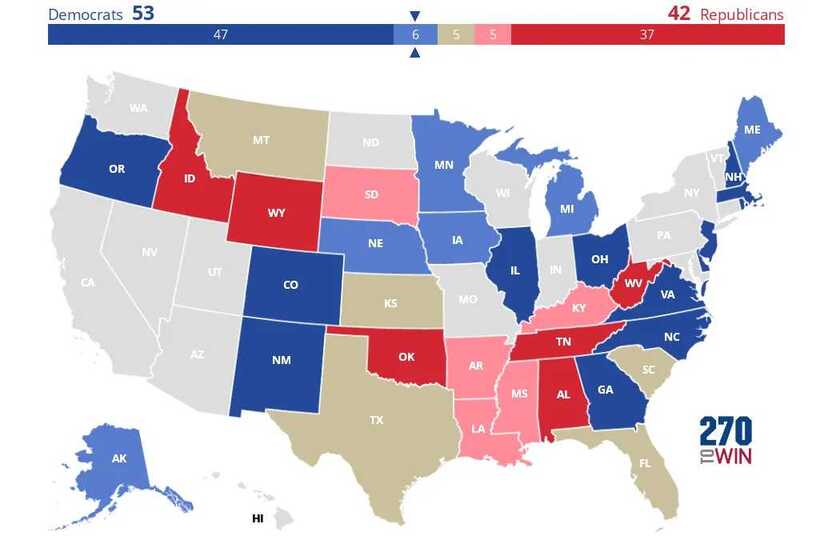
First, four factors dictate whether there is major turnover in the Senate in a midterm election independent of the favorability of the Senate map (due to only one-third of seats being up in any given midterm). Often, as was the case in both 2018 and 2022, is that incumbents are not destined to lose seats, outside of realigning elections in unfavorable maps. This cycle's map favors the GOP, which is why the prediction markets and most forecasters expect a GOP majority in the 2027 Senate. The four factors that prove dangerous to the incumbent party are: first, a recession or cost of living crisis; second, a war; third, a major scandal; and fourth, a sense of betrayal in the voter group that backed the incumbent amongst some portion of their prior electoral coalition. Five midterms feature some combingation of those factors in some significant degree: 1930, 1946, 1958, 1974 and 2006.
Without those factors present in multiple forms, the incumbent party can expect to hold on to seats in states it previously won outside the national margin. When those factors are present, the landscape shifts dramatically. Examining those White House incumbent seats that showed a state-wide election decided by single digits in the prior decade produces the following probabilities: the incumbent White House party lost at least 67% of its incumbent held seats, as much as 85% of its incumbent held seats, and an average of 75% of its incumbent hold seats, rarely upsetting the opposition party in any seat and often losing a surprise or two in seats considered completely safe.