





Historical Context
- Without war, recession or major scandal, the odds of the White House party losing 25+ House seats & 5+ Senate seats is a relative rarity in the post-WW2 modern era, covering 20 midterm elections. The Senate saw 5+ flips in 1946 (war ending), 1958 (recession), 1986 (midwest/farm recession), 1994 (evangelicals join the GOP down ballot), 2006 (Iraq war), 2010 (GFC recession) * 2014 (Obama hangover). That means in 15 of the last 20 midterms, the Senate saw little shift. Indeed, the party holding the White House has just as often gained seats in the Senate as lost them, including the last 2 midterm election cycles. The House saw 25+ house seats flip in 1946 (war ended), 1950 (Korean War), 1958 (recession), 1966 (Vietnam war), 1974 (Watergate), 1982 (recession), 1994 (evangelicals join GOP down ballot), 2006 (Iraq War), 2010 (GFC), and 2018 (anti-Trump). The House, with all seats up every cycle, are more vulnerable to swings against the party in the White House, but claims of inevitability are greatly overstated. Even the House is only 50-50 in the post-WW2 era in massive swings, with the most vulnerable swings occurring when one party has a lopsided edge in the House. Point in fact, since 1986, 60% of the time the House has not had a major 25+ swing in seats in midterm elections. The same rule holds for each part of Congress -- without war, recession or major scandal, massive shifts are far more uncommon than common. That said, when a war is raging or just ended, a recession haunts the economy, or a major scandal consumes the news, the odds of a major shift in at least one of the two houses of Congress is a perfect 7-for-7, and the odds of a major shift in both houses of Congress is 6-for-7. Without a recession, war or scandal, the odds of a big swing in both houses of Congress drop dramatically to just 2-for-13, with both coming in major realignment elections (evangelicals join GOP down ballot in 1994 & old Jacksonian Democrats from the reverse-L of eastern Oklahoma to western North Carolina, up through Kentucky and Ohio of Appalachian hearland swing away from Obama's Democrats).
2026
- GOP enters with a 3-vote edge in the Senate, with 53 Republicans, though they must lose 4 seats to lose control (due to VP's tie-breaking vote), and maybe even 5 (if Fetterman flips to vote with the GOP & Murkowski does not flip to the Dems). GOP enters with a 2-vote edge in the House, with 218 Republicans and 214 Democrats, and 3 vacancies representing 2 Republican-held seats, and 1 Democratic held seat. The Supreme Court's slow action reversing the Voting Rights Act limits the chance of effective redistricting, while redistricting currently net favors Democrats if the Virginia redistricting succeeds and the Texas redistricting in Mexican ancestral areas of Texas showed they likely trend Democratic in the recent primary. The current Iran war, the risk of looming recession, the possibility of lurking scandals, and the lost realignment of the Trump 2024 coalition all point to this cycle being a major shift in both houses. Baris' polls amongst the extremely enthused show Democrats with a double-digit lead on the generic ballot, unheard of in the contemporary era since the realignment of evangelicals in 1994.
2026 Senate
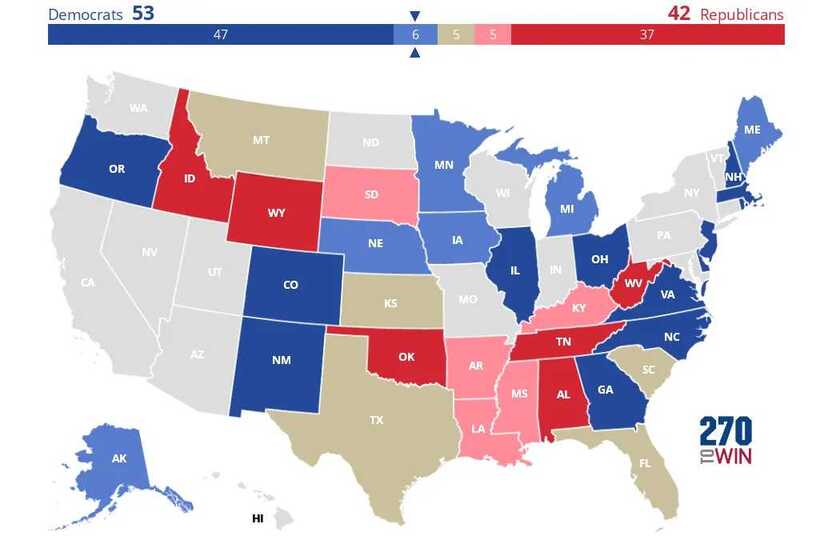
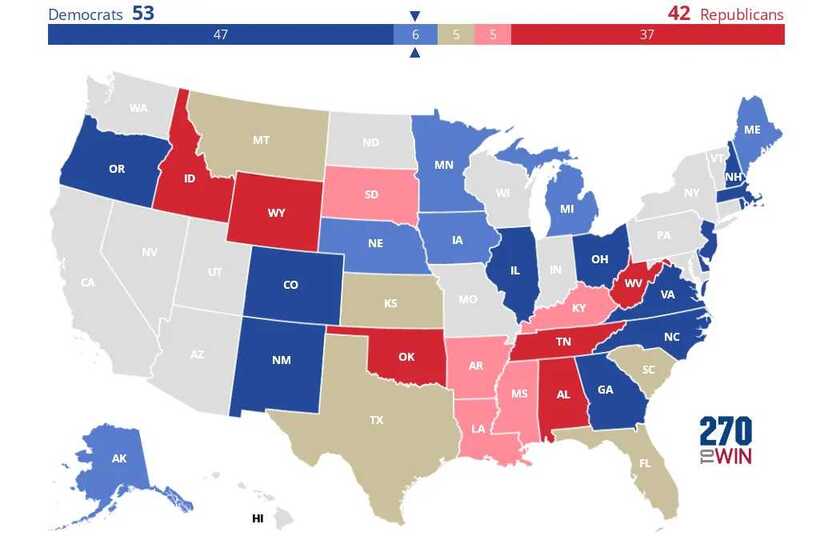
- The competitive seats identified by third party observers are: Maine, Michigan, Ohio, Iowa, North Carolina, Georgia, South Carolina, Texas, Nebraska, and Alaska. Currently, Republicans old all but 2 of these competitive seats, making them more vulnerable due to the map of seats up for election this cycle. Internal GOP polls and Baris' polls show the races already as a dead heat in Ohio, Iowa and Alaska, with the GOP candidate down in Maine, Michigan, North Carolina, and Georgia. Should Cornyn win the nomination in Texas and Graham in South Carolina, as well as the establishment candidates prevail in the GOP primaries in Iowa, GOP vulnerability increases due to up to one-third of GOP primary voters saying they will not vote for either in the general election. My odds for these states voting Democrats in the Senate are as follows for these 10 seats:
- Michigan: 95%
- Maine: 85%
- North Carolina: 80%
- Georgia: 75%
- Ohio: 65%
- Alaska: 65%
- Iowa: 60% (75% if Carlin loses the primary; 50% if Carlin wins the primary)
- Texas: 50% (65% of Cornyn is nominee; 35% if Paxton is nominee)
- South Carolina: 50% (65% of Graham is nominee; 35% if Lynch or Dans is nominee)
- Nebraska: 40% (Independent is one to watch)
- Senate Overall in 2027: 53-47 Democratic, with Murkowski likely to flip to the Democrats, and Fetterman staying put on the Democratic side, increasing that to 54-46 in voting terms. I set the odd of the Senate going Democratic at 80%.
House 2026
- The key competitive seats are in the industrial/rural midwest and the heavily Hispanic southwest, with both constituencies recent GOP converts now returning en masse to Democratic voting habits their voting ancestry supports. These are both war-sensitive demographics, as well as recession-sensitive demographics. The Democratic message of the Epstein Class vs the Working Class resonates deeply with these voter groups. Meanwhile, voter enthusiasm amongst GOP-leaning independents hit new lows in a range of voter surveys, evidenced by the 27-0 edge Democrats enjoy in flipping state legislative seats over the last 6 months or so & the lopsided Democratic edge in turnout in the Texas primaries (exceeding GOP turnout for the first time since 2002). I forecast only 1 currently heald Democratic seat flipping to the GOP: Texas CD 32; by contrast, I forecast 33 seats flipping to the Democrats, for a seat profile in 2027 House that is 246 Democrats, and 189 Republicans. I see the odds of the House going Democratic at 98%. These are the seats I see as likely flipping to the Democrats in 2026 midterms:
- Alaska At Large
- Arizona 1
- Arizona 2
- Arizona 6
- California 1
- California 6
- California 22
- California 48
- Colorado 3
- Colorado 5
- Colorado 8
- Florida 7
- Iowa 1
- Iowa 2
- Iowa 3
- Michigan 4
- Michigan 7
- Michigan 10
- Montana 1
- Nebraska 2
- New Jersey 7
- North Carolina 11
- Pennsylvania 1
- Pennsylvania 7
- Pennsylvania 8
- Pennsylvania 10
- Tennessee 5
- Texas 15
- Utah 1
- Virginia 1
- Virginia 2
- Wisconsin 1
- Wisconsin 3