MiracleManDan's AI World Cup
This is purely experimental. Posting for posterity, let's see if the model comes anywhere close to predictive.
1. Group Winner Value (p_group_win vs odds)
+EV bets (model p_group_win > implied from the odds):
• Turkey (D) @ +175 → +13.4% edge (model 49.8%)
• Ecuador (E) @ +390 → +13.2% edge (model 33.6%)
• Iran (G) @ +650 → +9.2% edge (model 22.5%)
• South Korea (A) @ +333 → +7.1% edge (model 30.2%)
• Switzerland (B) @ -125 → +6.0% edge (model 61.6%)
• Czech Republic (A) @ +400 → +4.9% edge (model 24.9%)
• Argentina (J) @ -300 → +4.6% edge (model 79.7%)
• Australia (D) @ +700 → +4.6% edge (model 17.1%)
• France (I) @ -250 → +4.5% edge (model 75.9%)
• Paraguay (D) @ +375 → +4.2% edge (model 25.2%)
• Colombia (K) @ +250 → +4.2% edge (model 32.8%)
(Strong fades on the other side include USA, Germany, Mexico, Canada, Belgium, etc.)
2. Advance (Yes / Qualify) Value (p_advance vs american_odds_yes)
+EV bets (model p_advance > implied from the yes odds):
• Qatar (B) @ +300 → +19.6% edge (model 44.6%)
• Australia (D) @ -110 → +12.1% edge (model 64.5%)
• Iran (G) @ -200 → +11.1% edge (model 77.7%)
• Turkey (D) @ -400 → +10.0% edge (model 90.0%)
• Paraguay (D) @ -200 → +8.6% edge (model 75.3%)
• Panama (L) @ +175 → +7.9% edge (model 44.2%)
• Uzbekistan (K) @ +162 → +7.7% edge (model 45.9%)
• Curaçao (E) @ +900 → +6.2% edge (model 16.2%)
• Japan (F) @ -350 → +4.2% edge (model 82.0%)
• South Korea (A) @ -275 → +3.8% edge (model 77.1%)
• Croatia (L) @ -450 → +3.6% edge (model 85.5%)
(Strong fades on the advance side include USA, Ghana, Canada, DR Congo, etc.)
3. Dont Advance (No) Value (model 1 - p_advance vs implied from american_odds_no)
+EV bets on the No side (model thinks the team is more likely to miss advancement than the no-odds imply):
• USA (D) @ +450 → +38.9% edge (model p_dont 57.1%)
• Ghana (L) @ +100 → +19.8% edge (model p_dont 69.8%)
• Canada (B) @ +450 → +16.2% edge (model p_dont 34.4%)
• DR Congo (K) @ -150 → +12.9% edge (model p_dont 72.9%)
• Jordan (J) @ -334 → +8.3% edge (model p_dont 85.2%)
• Mexico (A) @ +600 → +6.5% edge (model p_dont 20.8%)
• Iraq (I) @ -450 → +6.3% edge (model p_dont 88.1%)
• Tunisia (F) @ -175 → +5.4% edge (model p_dont 69.0%)
• Ivory Coast (E) @ +300 → +4.0% edge (model p_dont 29.0%)

World Cup - My Futures Picks
1-2.5% Over x.5 Penalty Shootouts (good to over 7.5 at 50c/+100)
0.5-1% Over x.5 Games go to Extra Time (good to over 10.5 at 50c/+100)
1% Winning Continent South America at 22c (good to at 30c)
1% Brazil to Win the World Cup at 8.2c (good to 15c)
0.5% Japan to Win the World Cup at 1.9c (good to 4c)
In four days the World Cup will begin, hosted jointly by the USA, Canada and Mexico. This will be the first world cup in the expanded 48 team format, with a group stage having 12 groups of 4, the top two advancing to the last 32 along with the 8 best third placed teams as ranked by points and goal difference. The European Championship has a similar format but with 24 four teams advancing to the last 16 while the World Cup had 24 teams between 1982 and 1994, with the best third placed teams format starting in 1986. Incidentally, the last time the World Cup had the best third place teams progress from the group stages was when the USA hosted the competition in 1994.
Although 32 years ...
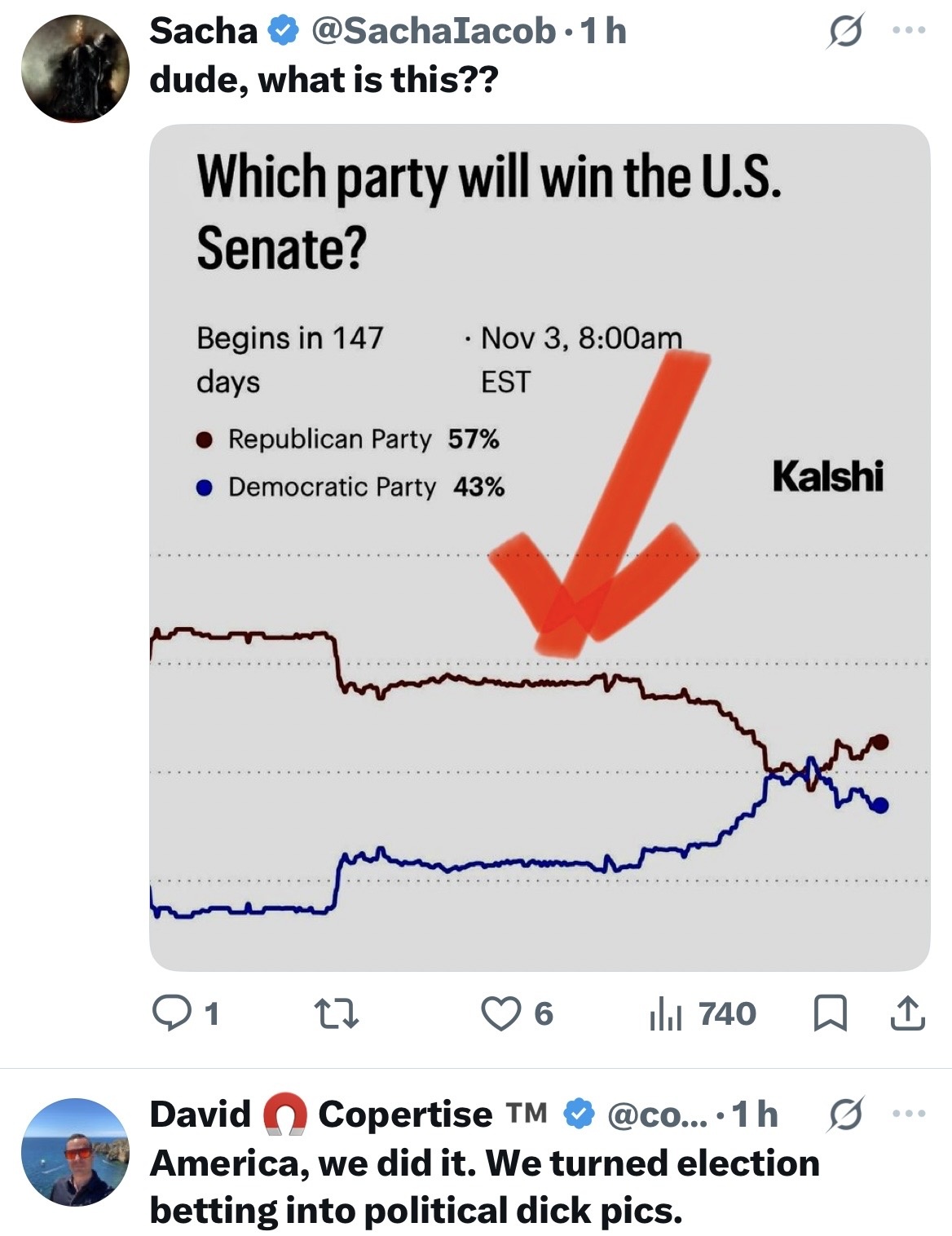
First, four factors dictate whether there is major turnover in the Senate in a midterm election independent of the favorability of the Senate map (due to only one-third of seats being up in any given midterm). Often, as was the case in both 2018 and 2022, is that incumbents are not destined to lose seats, outside of realigning elections in unfavorable maps. This cycle's map favors the GOP, which is why the prediction markets and most forecasters expect a GOP majority in the 2027 Senate. The four factors that prove dangerous to the incumbent party are: first, a recession or cost of living crisis; second, a war; third, a major scandal; and fourth, a sense of betrayal in the voter group that backed the incumbent amongst some portion of their prior electoral coalition. Five midterms feature some combingation of those factors in some significant degree: 1930, 1946, 1958, 1974 and 2006.
Without those factors present in multiple forms, the incumbent party can expect to hold on to seats in states it previously won outside the national margin. When those factors are present, the landscape shifts dramatically. Examining those White House incumbent seats that showed a state-wide election decided by single digits in the prior decade produces the following probabilities: the incumbent White House party lost at least 67% of its incumbent held seats, as much as 85% of its incumbent held seats, and an average of 75% of its incumbent hold seats, rarely upsetting the opposition party in any seat and often losing a surprise or two in seats considered completely safe.