




MLB F5 MLB System Kalshi
Cleveland Indians F5
strongest play
1. S-Tier Plays (Diff ≥ 2.50)
• SD F5 (Rodriguez over Leahy) — Diff ~3.3 | 70%+
• MIA F5 (Alcantara over Painter) — Diff ~3.6 | 70%+
• BOS F5 (Bennett over Scherzer) — Diff ~3.2 | 70%+
• CLE F5 (Williams over Sproat) — Diff ~4.2 | 70%+
2. A-Tier Plays (Diff 1.75–2.49)
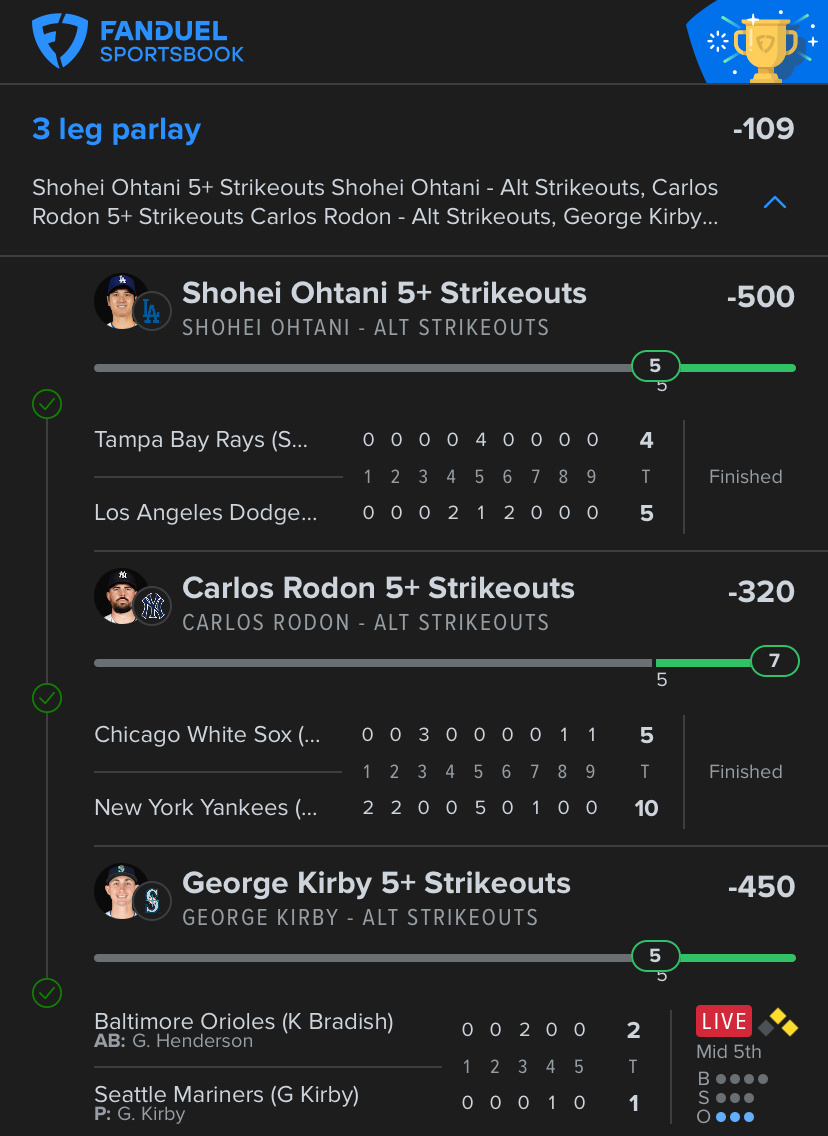
• LAD F5 (Ohtani over McClanahan) — Diff 2.3 | 64–66%
• DET F5 (Mize over Lambert) — Diff 1.8 | 61–63%
• NYY F5 (Rodón over Kay) — Diff 1.8 | 61–63%
3. Underdog Pitching Edges
• BOS — Bennett significantly better than struggling Scherzer (strong underdog-side advantage)
• SD — Rodriguez dominant small-sample profile vs Leahy
• MIA — Alcantara clear step up vs Painter
• CLE — Williams far superior to Sproat
4. Strongest Edge On Slate
CLE F5 (Williams) — Largest Diff (~4.2) with established sample for Williams and clear weakness in Sproat.
Close second: LAD F5 (Ohtani) for elite ceiling + home context.
5. Daily Top 5 Ranked Plays (by Diff + profile strength + sample confidence)
1. CLE F5 (Williams) — S-Tier, massive Diff
2. SD F5 (Rodriguez) — S-Tier, elite small-sample but high-upside
3. MIA F5 (Alcantara) — S-Tier, reliable veteran edge
4. BOS F5 (Bennett) — S-Tier, exploitation of Scherzer collapse
5. LAD F5 (Ohtani) — A-Tier, best individual pitcher on slate
MLB F5 SYSTEM
June 18, 2026 — Early Games Only (3 games)
Strongest edge on the slate: MIN F5 (Joe Ryan dominates).
Best value plays: MIN F5 (S-Tier) and CLE F5 (A-Tier).
Tiered Plays
S-Tier (Diff ≥ 2.50)
• MIN F5 (Joe Ryan over Jack Leiter) — Diff 3.7 | 70%+
A-Tier (Diff 1.75–2.49)
• CLE F5 (Parker Messick over Shane Drohan) — Diff 1.8 | 61–63%
B-Tier (Diff 1.00–1.74)
• BOS F5 (Sonny Gray over Trey Yesavage) — Diff 1.2 | 57–60%
Top 3 Ranked Plays
1. MIN F5 (Joe Ryan) — S-Tier Elite 2026 metrics + heavy recent weighting vs struggling Leiter.
2. CLE F5 (Parker Messick) — A-Tier Outstanding 2026 numbers (low ERA/WHIP) in 14 starts.
3. BOS F5 (Sonny Gray) — B-Tier Veteran edge in a closer matchup.
Key Notes
• MIN F5 is the clear #1 edge today — massive profile gap.
• Messick continues to look like one of the best young arms in the league.
• All three games have clear pitching advantages per the model.
Pure pitching model — No odds or market data used.
First, four factors dictate whether there is major turnover in the Senate in a midterm election independent of the favorability of the Senate map (due to only one-third of seats being up in any given midterm). Often, as was the case in both 2018 and 2022, is that incumbents are not destined to lose seats, outside of realigning elections in unfavorable maps. This cycle's map favors the GOP, which is why the prediction markets and most forecasters expect a GOP majority in the 2027 Senate. The four factors that prove dangerous to the incumbent party are: first, a recession or cost of living crisis; second, a war; third, a major scandal; and fourth, a sense of betrayal in the voter group that backed the incumbent amongst some portion of their prior electoral coalition. Five midterms feature some combingation of those factors in some significant degree: 1930, 1946, 1958, 1974 and 2006.
Without those factors present in multiple forms, the incumbent party can expect to hold on to seats in states it previously won outside the national margin. When those factors are present, the landscape shifts dramatically. Examining those White House incumbent seats that showed a state-wide election decided by single digits in the prior decade produces the following probabilities: the incumbent White House party lost at least 67% of its incumbent held seats, as much as 85% of its incumbent held seats, and an average of 75% of its incumbent hold seats, rarely upsetting the opposition party in any seat and often losing a surprise or two in seats considered completely safe.