


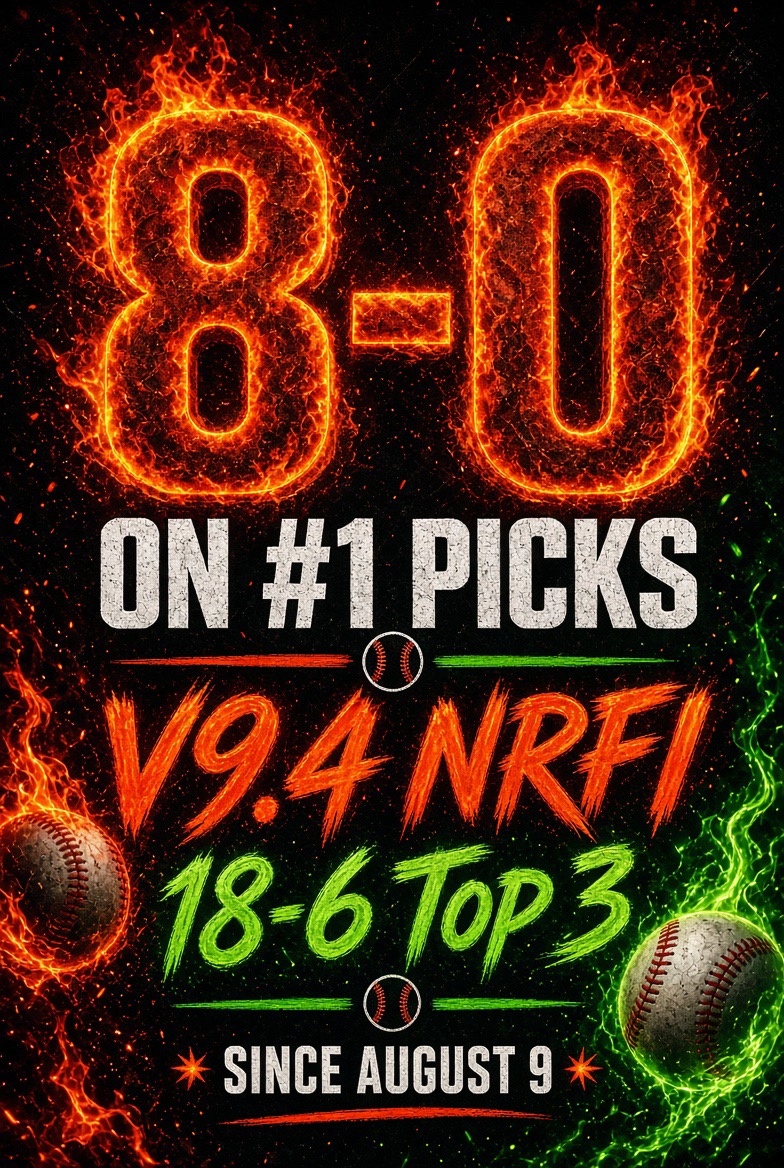



🔥 SEA @ HOU – Strong Dual-Pitcher Spot
Both starters are rocking 83% NRFI rates this season:
• Bryan Woo – 19-4 (83%)
• Hunter Brown – 10-2 (83%)
That’s a rare dual 83%+ matchup in a dome. Controlled environment, no wind, no weather variables. Both guys have been stingy early all year and the market is only asking around -115.
This one sat just outside the Top 3 purely because the team 1st-inning rates are a bit softer, but the pure pitcher strength + dome combo makes it a very real NRFI candidate. High floor dual-arm play.
#NRFI #Mariners #Astros
Full Straight-Prop Analysis
Ranking driven purely by projected strikeout strength (blended K/9 + recent form + efficiency + matchup SO/G via Smart Tiered Weighting + Extension/Movement/Stuff boosts). Live lines ignored for ranking. Elite Tier locked into Top 3.
Top 5 Overs
1. Dylan Cease (TOR vs NYY) – Elite Tier (mandatory lock). Blended K/9 ~13.1, Last 5 AVG 8.6, elite SwStr%/stuff. Smart weighting 68/32 (or 73/27 vs high SO/G NYY Away ~9.54). High Workload/efficiency supported. Projected strength elite.
2. Tarik Skubal (LAD vs MIL) – Elite Tier (mandatory lock). Blended K/9 ~10.7, Last 5 AVG 7.8, elite FB/stuff. Weighting 68/32 vs MIL Away ~8.48. Clean workload.
3. Christian Scott (NYM vs WAS) – Elite Tier (mandatory lock via K/9 ≥10.5 + recent form). Blended K/9 ~11.3, Last 5 AVG 6.6. Strong efficiency. Weighting favorable vs WAS Away ~8.94.
4. Logan Henderson (MIL @ LAD) – Strong/Elite borderline (K/9 11.0). Last 5 AVG 7. Extension/movement + stuff boost lifts him. Weighting 62/38...
First, four factors dictate whether there is major turnover in the Senate in a midterm election independent of the favorability of the Senate map (due to only one-third of seats being up in any given midterm). Often, as was the case in both 2018 and 2022, is that incumbents are not destined to lose seats, outside of realigning elections in unfavorable maps. This cycle's map favors the GOP, which is why the prediction markets and most forecasters expect a GOP majority in the 2027 Senate. The four factors that prove dangerous to the incumbent party are: first, a recession or cost of living crisis; second, a war; third, a major scandal; and fourth, a sense of betrayal in the voter group that backed the incumbent amongst some portion of their prior electoral coalition. Five midterms feature some combingation of those factors in some significant degree: 1930, 1946, 1958, 1974 and 2006.
Without those factors present in multiple forms, the incumbent party can expect to hold on to seats in states it previously won outside the national margin. When those factors are present, the landscape shifts dramatically. Examining those White House incumbent seats that showed a state-wide election decided by single digits in the prior decade produces the following probabilities: the incumbent White House party lost at least 67% of its incumbent held seats, as much as 85% of its incumbent held seats, and an average of 75% of its incumbent hold seats, rarely upsetting the opposition party in any seat and often losing a surprise or two in seats considered completely safe.