SportsPicks
Politics • Investing & Finance • Sports
All your sports information for those investing Vegas-style in the outcomes of sports games. Predicting games against the line in all sports, especially football, American and English style.
Interested? Want to learn more about the community?

European Football Review - 9th-12th October 2026

For the first five weeks of the season, I had approached reviewing football played across Europe by reviewing selected games, with a focus on the Premier League, where I covered every game, and Serie A, where I covered a small number of games in depth due to the tactical intricacies involved. This is quite an intensive process, and after five weeks taking us up to the long international break, I believe I have enough of a feel for how the leagues are going that I can start projecting how certain tactical interactions hold up across different teams. I will still review selected games here and there but I am going to place more of a focus on writing up picks and analysing overall trends. I will be linking to more articles for light bedtime reading, and a lot of my articles will come from www.ultimouomo.com, an Italian language publications that goes into detail on the tactical side of football, especially in Serie A. Even though the articles are all in Italian, I would encourage you to read them anyway as machine translation is readily available. I will refer to other sites too, such as www.coachesvoice.com or sites specific to a particular club, like intothecalderon.com when referencing Atlético Madrid, for example.

So a few articles to consider for the past weekend:

Shifts and changes in Serie A

https://ultimouomo.com/5-statistiche-dimostrano-che-la-serie-a-2026-27-cambiata

This is an article reviewing the first five weeks of Serie A, in which it notes that the league has been more explosive and exciting compared to recent years. Whereas Serie A has traditionally been known as a very defensive, tactical league in which a lot of attention is placed on nullifying your opponent's advantages and responding to the changes they make, this season has retained the distinctly Italian tactical flavour while living with more goals volatile play. In a previous article it is mentioned that Serie A underwent some rule changes mirroring those that were active at this year's World Cup, designed to penalise timewasting. The result is more exciting games, at least so far and the article does note that we have a limited sample size.

A theme of some of the articles on the site is that Italian football may have a very clear and self confident sense of its own identity, but it also questions itself, looks at developments in other leagues and asks what Italian football will look like over the coming decade. Will it spurn the major trends in world football in favour of what has worked or will it adapt and potentially lose its identity in the process? There is a lot of space in between but so far it appears that Italian football is going in a new direction, one in which trying to extract cynical penalties is not quite as powerful a strategy as it used to be. I have posted before about how every league is different but Serie A deserves its own unique treatment to understand properly. I believe it will require careful attention to determine what methods will work best for it this season and so the linked article is a very useful reference point for how the season is developing.

Como 0-0 Roma

https://ultimouomo.com/como-roma-0-0-come-gasperini-ha-neutralizzato-fabregas-analisi-tattica

I have mentioned in previous posts that a couple of teams in Serie A have been particularly stubborn to bet against this past year. One of these is Como. Promoted two years ago, Como have undergone a significant rise under Cesc Fàbregas, finishing in the Champions League places ahead of Juventus and AC Milan. Although Como's big game record last year wasn't spectacular by the standards of a Champions League aspiring team, it was nonetheless far beyond what many expected that games involving them and the Italian giants would be referred to as big games in their own right. Como's style under Fàbregas is a positional orientated system based on manipulating the opponent's shape and then attacking the spaces that emerge. Roma are in their second season under Gian Piero Gasperini, who plays a man orientated positional game. Now there is a considerable degree of hybridisation in modern football, where generally zonal systems may go man orientated on certain vectors of opposition attack while generally man orientated systems may go zonal in certain circumstances. For the most part, Como vs Roma is a fixture in which one system is principally zonal and the other system principally man orientated.

The man vs zonal debate is not new. I remember when zonal marking became more common in the Premier League in the 2010s with Liverpool using it under Rafael Benitez. It allowed Liverpool's defence to cover space very efficiently for a squad that did not have the highest market cap at the time but it also left times when one of their zones would get overloaded and an opposing player would score from the resulting space. Man orientated systems at the time were insistent that someone had to be responsible for the would be goalscorer. In that era, players were trusted to work problems out on the pitch to a much greater degree, it was demanded of them even. The 2010s saw zonal systems become much more common as they allowed teams to make sets of players with lower transfer market valuations relatively very competitive and top teams were relying less on generational talents such as Paul Scholes or Andrea Pirlo. Nonetheless, there are tradeoffs between zonal and man orientated that influence where they are most effective. Man orientated systems give you more control over the action on the pitch as your players are able to judge where your opponent's weak points are and exploit them. Zonal systems on the other hand are useful for ensuring structural integrity, preventing your players from becoming isolated against those of your opponent in unfavourable matchups.

Roma and Como played each other twice last season, with each team winning once. Roma's man orientated system allows its players to purse opposition players further than they would in other systems. Whereas a defender may back off when an attacker retreats far enough back, a defender under Gasperini may pursue said attacker considerably further. Como were able to bait this last year, which opened up space for them. The game between these two at the weekend was a rematch of these tactical systems and this time Roma approached it slightly differently. They targetted the centre so Como didn't have a chance to conduct play easily through central midfield. This funnelled play out to the wings where they were able to more easily manage Como's attacks. Como's goalkeeper Jean Butez normally participates in Como's buildup play. Roma did not press quite so aggressively so as not to give him the chance to find space behind them. The result was that despite Como dominating possession, Roma had the better of the first half chances.

In the second half, Donyell Malen was sent of for Roma, and so they played a considerable section of the game with ten men. This is where a team like Como can become really dangerous because with that extra man, they can patiently probe and find the extra space until an opening emerges for a chance. Gasperini sacrificed the opportunity to press man to man up front to match Como's buildup in midfield. Fàbregas brought on Jesús Rodriguéz to provide width and find space on Roma's flanks. Gasperini dropped Nahuel Molina back to cover the space. Fàbregas switched from a four man defence to a three man defence before the end but it wasn't enough for Como to find a breakthrough.

To assess a team's overall strength and compare it to where the markets have them is in certain ways the easy part. The difficult work begins in assessing through what mechanisms they are strong and where they are more exposed to needling from other teams. A team like Como was able to find an edge against a team like Roma last year but this weekend showed that this time, Roma had a response. This will help us to better understand these teams and how they play as interactions between mechanisms is ultimately how these games are won and lost, or drawn. In this week's Champions League, Como are away to Feyenoord and Roma are at home to Real Madrid. Both will be very interesting fixtures.

Liverpool 0-3 Manchester City

The first game since Manchester City were found guilty of 114 out of 115 charges of breaching Premier League financial regulations, Liverpool were also looking for their first Premier League home win under Andoni Iraola. Liverpool did not start terribly and until Ryan Gravenberch's red card after the hour mark, they had generated the better of the chances. What followed was three goals in a quarter of an hour as Manchester City exploited the gap that emerged in Liverpool's midfield. When a team has a player receive a red card, it affects live game lines depending on the player, how far into the game it is and the balance of power between the teams. Generally it amounts to quite a noticeable blow, but on its own it does not decide the outcome. The resulting space that emerges from their absence is where it ultimately impacts the game. Some teams are very good at ensuring the rest of the team denies the space from being exploited by the other team while others find their players becoming increasingly stretched as the other team exploits their pressure points. Last month Manchester City were able to hold out and win against Manchester United after playing most of the match with ten men. Now it was City's turn to wield a man advantage during the most critical times of the contest.

Manchester City's playstyle is a positional orientated system where Enzo Marseca took over from Pep Guardiola in the summer. Maresca's team has as its base Enzo Fernández and Eliot Anderson, two very physical all round midfields signed in the summer. What is notable about them is they are well able to carry the ball and resist the opponent's press. Against Andoni Iraola, who plays a high intensity pressing system, City's midfield was well equipped not to be overwhelmed by Liverpool's. This does not mean that they had the upper hand as Liverpool were able to find some spaces around them and generate some chances, but they weren't especially vulnerable to Liverpool's approach. When Gravenberch was sent off, that was when Maresca's system of positional rotations designed to continuously make space from successive movements, Liverpool were no longer able to keep up. As they defended deeper they were able to protect the space behind them but were not able to as effectively contest the ball higher up the pitch.

Florian Wirtz is a recurring tension in Liverpool's system as he is a player who functioned very effectively in Xabi Alonso's Bayer Leverkusen system from several years ago but he has looked somewhat mismatched with the squad that Jurgen Klopp left behind that Arne Slot brought him into. Now under Iraola, he yet again looks like a player for the wrong system, capable of being a key player in a positional system but not in a high intensity pressing system where every bit of space matters. Liverpool may have been able to protect their flanks after a chaotic opening two games but their defeat at home to Manchester City has shown that the structure that holds up their system is fragile and that they are capable of spiralling if they receive a serious setback. Manchester City have won all eight of their competitive games under Enzo Maresca and now face Champions League holders PSG who have endured a rocky start to the season. A lot will depend on whether or not PSG have managed to correct course during the international break.


Interested? Want to learn more about the community?
What else you may like…
Videos
Podcasts
Posts
Articles
Barnes Brothers: European Soccer Preview
00:54:00
Master Class: Prediction Markets vs Sportsbooks

In this edition of "Master Class", we're gonna look at Prediction Markets vs Sportsbooks, and why the Prediction Markets are the Future of Sports Betting!! Come join us, as we try to provide you with all the tools to STACK YOUR NICKELS TO THE CEILING!! Feel Free to drop any questions you have in the comments!! Hope This Helps My Friends!! Good Luck, Good Gamblin, & Have The Day You Deserve!!

-Crickett

00:51:21
Barnes Brothers: European Soccer MEGA Preview
01:08:49
SEC Preview Podcast

A full breakdown of every team in the SEC, including talent analysis, coordinator concern, and schedule forecasts, with win total expectations. Enjoy!

SEC Preview Podcast
Smokehouse Mike's NCAAB

March Madness final four recap and Championship preview...

Smokehouse Mike's NCAAB
Smokehouse Mike's NBA
LIVE CHAT FOR 2026

Now open!

Premier League 17th October 2026 - My Picks

2% Chelsea not to win vs Everton at 59c (good to 63c)
1% Over 9.5 Corners at 53c (good to 60c)

Everton host Chelsea in the early afternoon kickoff and this is a fixture at home to a big six team where David Moyes is known for his meticulous preparation. Everton under him have a very direct, physical playstyle where they look to contest the ball in midfield, hit crosses directly into the box and maintain a compact unit out of possession, playing quick balls up the pitch when they regain possession. Everton under Moyes target set pieces, which is where they are able to win balls in the air and compete for second balls. I expect Everton to use these methods to challenge Chelsea today.

Chelsea under Xabi Alonso play a positional style based around manipulating the opponent's shape and stretching the space available to them. They attack through the wings a lot and Chelsea's forward players have a lot of freedom to attack. This does leave gaps...

Crick's Picks: NCAAF - Week 7

FADE ME CAUSE I'M A BUM!!!!!!

You & Your Beautiful Families STAY SAFE Out There!!! Good Luck & Good Gamblin!!!!

ATS = Against The Spread

ML = Money Line

ALT = Alternate Spreads

TT = Team Total

SGP = Same Game Parlay

1Q, 2Q, etc. = Bet Is Only For That Individual Quarter

1H & 2H = Bet Is Only For That Individual Half

1/2-Unit = 50% Unit (.5 Units)

1/4-Unit = 25% Unit (.25 Units)

SPRINKLE = At Your Discretion (DON'T GO CRAZY!!!!)

THESE ARE NOT SPORTSPICKS "OFFICIAL PICKS"

ALL MY ODDS COME FROM DRAFTKINGS

Crick's Picks Results: Week 6/YTD

Week 6

  • 1-9 ATS -21.14 Units

0-1 (5-Unit Plays)

0-2 (3-Unit Plays)

1-6 (2-Unit Plays)

  • 1-1 ML +.54 Units

1-1 (1-Unit Plays)

College Football: Week 5 - Overall = -20.6 Units

Year To Date

  • 27-30-1 ATS -21.26 Units

0-2 (5-Unit Plays)

4-6 (3-Unit Plays)

22-22-1 (2-Unit Plays)

1-0 (1-Unit Plays)

  • 4-13 ...
post photo preview
September 14, 2026
post photo preview
Barnes Betting Report: Monday Night Football
Chiefs-Broncos
 
REB Power Ratings
CHIEFS: 7 points better than average
BRONCOS 3 points better than average
Home edge for KC: +2.5
REB Spread: Chiefs by 6.5
REB Moneyline: Chiefs 67%
REB Total: 41
PFF Talent: Favors Chiefs on both sides of the ball
 
Situational Analysis
Coaching: Reid is one of the best ever as is Spags, whereas Payton gives up playcalling for the Broncos and Joseph has had some erratic spots in his career. 
Key Market Trends: Chiefs as 3 points or less: 70% cover rate; Reid has a 65% success rate against the spread in week 1; Nix average QB rating on road is 85 while Mahomes exceeds 100 at home; Denver’s offense against top-5 defenses on the road scores a median of 17 points while Chiefs offense under Mahomes is 27. Public tickets favor the Broncos by a 2 to 1 margin. 
 
Talent according to PFF
Players I expect to have 70+ ratings this season, using PFF's past season grades and match for scheme...
 
Chiefs Defense
CB SNEED
CB WILLIAMS
S ROLAND-WALLACE
S GILMAN
LB TRANQUILL 
LB BOLTON
LB COLTRANE
DE KARLAFTIS
DT JONES
 
Broncos Offense
LT BOLLES
RG MEINERZ
RT MCGLICNHEY
TE ENGRAM
WR WADDLE
WR SUTTON
QB NIX
 
Chiefs Offense
C HUMPHREY
G SMITH
WR WORTHY
WR RICE
RB WALKER
QB MAHOMES
TE KELCE
 
Broncos Defense
S HUFANGA
CB SURTAIN
DE BONITTO
DT JONES
DE ELLISS


Read full Article
post photo preview
Forecasting the Senate in 2026

Two conflicting trends dictate the Senate outcome in 2026. The map heavily favors Republicans, as the competitive Senate seats up lean heavily Republican. By contrast, the election context heavily favors Democrats, with war, recession, realignment and scandal tipping in their direction. A deeper dive reveals why prediction markets still likely undersell Democratic prospects.

First, the idea that Senate midterms favor the party out of power in the White House is belied by both recent and a century of history of Senate elections. Unlike the House, only a third of Senate seats face election in any midterm, and that map dictates outcomes unless the election context is particularly bad for the incumbent party.

Consider that the highly unpopular Biden didn’t lost any net Senate seats in 2022 and Trump added Senate seats in the Democratic friendly cycle in 2018. Equally, Clinton didn’t lose net Senate seats in 1998 nor did W. in 2002. Even low-approval election cycles like 1966 and 1982 didn’t produce a big swing in the Senate. Indeed, since 1934, the party in power only lost 10% or more of their Senate seats (4+) less than half of the time. Democrats need a flip of exactly that — at least 4 Senate seats — to retake power in the Senate.

Then take a look at the map, and you can see the reason for optimism in GOP circles and some traders in the prediction markets. Only 2 GOP-held seats are in states Trump won by less than double digits, while 2 Democratic-held seats are in states Trump won, and one of those GOP held seats features a long-time incumbent who typically runs double-digits ahead of the GOP norm (Collins in Maine). This is why the GOP entered the year believing odds of losing the Senate were remote, and the prediction markets mostly concurred.

But this ignores the counter-trend: the degree of election dismay with the incumbent party in the White House, and the reasons for that dismay. Presidential job approval has not been a neat proxy for Senate midterms because it depends on the reason for that dissatisfaction in the electorate. Four factors drive Senatorial midterms: war, recession/cost of living, realignment, and scandal. When two of those four factors are not present and don’t dominate, then the incumbent party’s odds of losing 4+ Senate seats drops to less than 20%. By contrast, when two of those four factors are present and do predominate, then the odds of the incumbent party losing 4+ Senate seats rises to 100%. Indeed, the median number of Senate seats lost when some combination of war, recession, realignment and scandal, are present, the White House party loses at least 8 Senate seats.

A few examples: while FDR added Senate seats in 1934 midterms, he lost 9 in 1938 midterms due to the combination of recession and scandal (trying to stack SCOTUS). 1942 and 1946 gave us war and recession to cost Democrats 8 and 12 Senate seats alike. 1950 gave us war again and scandals concerning the war costing Democrats 5 Senate seats. 1958 gave us recession and scandal, costing Ike 15 Senate seats. While JFK added Senate seats in 1962 and Nixon added Senate seats in 1970, only Watergate and stagflation in 1974 or the combination of Iran Contra and vulnerable class of 1980 incumbents cost the incumbent party 4 or more Senate seats until the realignment election of 1994, where evangelicals shifted their down-ballot voting to the GOP en masse. It took war and scandal in 2006 to see the Senate switch 4+ Senate seats again.

That’s the story of 2026: a very GOP favorable Senate map versus a very Democratic friendly election cycle. The GOP enters election season with all four factor present: war, recession/cost of living, realignment, and scandal. The Iran War was already deeply unpopular, and it’s impact on the economy in gas and diesel prices turns Americans sour on their current economic prospects, as wages fall behind, housing and health care feel increasingly unaffordable, labor force participation continues to drop, the the mirage of AI keeps the GDP just above a technical recession. The Epstein scandal remains one of the worst scandals in American political history, and Trump managed to associate himself deeply with the scandal in his handling of it. Then the realignment, as the new Trump 2024 voters joined the Obama-Trump converts of 2016 in abandoning GOP identity, already evident in surveys and primary participation.

A quintet of voter groups appear to be realigning away from the Republican brand — hispanic voters, black voters, industrial area voters, libertarian-leaning voters, and war-skeptical voters alike. This realigning electorate shows up disproportionately in key Senate contests. The war-skeptical voters in states like Maine, New Hampshire, Ohio, Michigan, Iowa, Montana, Nebraska, and Alaska (these are the states W failed to gain in between 2000 and 2004 due to the Iraq War before it even turned unpopular). The hispanic voters in states like Florida and Texas. The African-American voters in states like North Carolina and Georgia. The industrial voters in Ohio and Michigan. The libertarian leaving voters in states like New Hampshire, Alaska, Texas and Florida.

Thus, many of the states that seem “Safe” on the map are anything but, as their realigning electorates shift back against the Republican brand, with all of them having recent histories in electoral cycles of favoring Democrats or being true swing states. Take states like Florida and Texas where suburban margins began to erode for the GOP in the Trump era but countered that by massive margin shifts in hispanic and black precincts. Primary participation, voter identification, and public opinion surveys show those black and hispanic voters shifting back massively away from the GOP brand, which, given the erosion in some suburban areas and losses with younger generations, makes states Florida and Texas closer to competitive than double-digit leans.

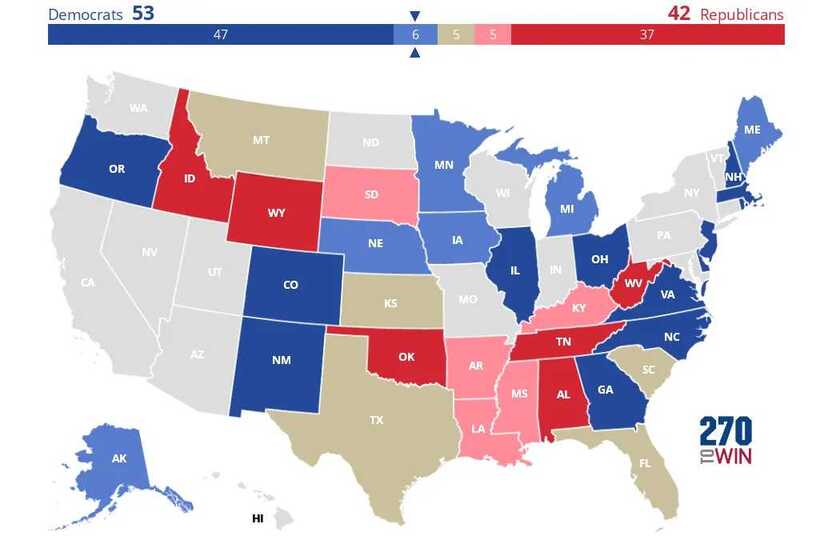
In big swing election cycles, even “safe” Senate seats can suddenly turn razor close, as Bob Dole found out in 1974, barely holding on to his Kansas seat before being the VP nominee two years later. Strong independent candidates in Kansas, Nebraska, South Dakota and Montana may pose a unique threat to GOP held seats, as the Nebraska race in 2024 showed, with Osborn running 17 points ahead of Harris’ margin in the state. Democrats field the much better candidate in Ohio with a proven track record of out-performing Democratic margins in the state, while the Texas GOP nominee faces abandonment from his own party after they spent over $100M bashing him in the state for a disliked party incumbent. Alaska primary results suggest the Democratic nominee already holds the edge in that ranked choice voting state, while the famed cross-over support for Collins in Maine appears to be fading with newer generations taking over the voter rolls. My current map would be as follows, with surprising closer-than-expected races in Montana, Kansas, Louisiana, Florida, Mississippi, South Dakota, South Carolina and Kentucky, and a median map of Democrats holding 53+ Senate seats after the 2026 elections.


If past is prologue, the map won’t save the GOP in 2026, and an ever bigger tsunami may be incoming than anyone in Washington expects.

Read full Article
post photo preview
OFFICIAL PICKS: Midterms, 2026
House Elections Projections
 
The House tends to be more responsive to midterm dynamics, but, like the Senate, swings hard in elections where some combination of the Four Factors are present -- cost of living crisis or recession; war; major scandal; betrayal or down-ballot realignment. A fun map to use is this simulator, which takes partisan averages from existing models, and plugs in the map based on your adjustment of the generic ballot edge for one party or another. https://globalelectionsimulator.com/#/usa-house
 
Historic Norms: When a combination of the Four Factors are present, this is the kind of swing you get:
1930: 52 seat swing
1946: 55 seat swing
1958: 49 seat swing
1974: 49 seat swing
1994: 54 seat swing
2006: 31 seat swing
 
2026 PROJECTIONS


Only for Supporters
To read the rest of this article and access other paid content, you must be a supporter
Read full Article
See More
Available on mobile and TV devices
google store google store app store app store
google store google store app tv store app tv store amazon store amazon store roku store roku store
Powered by Locals