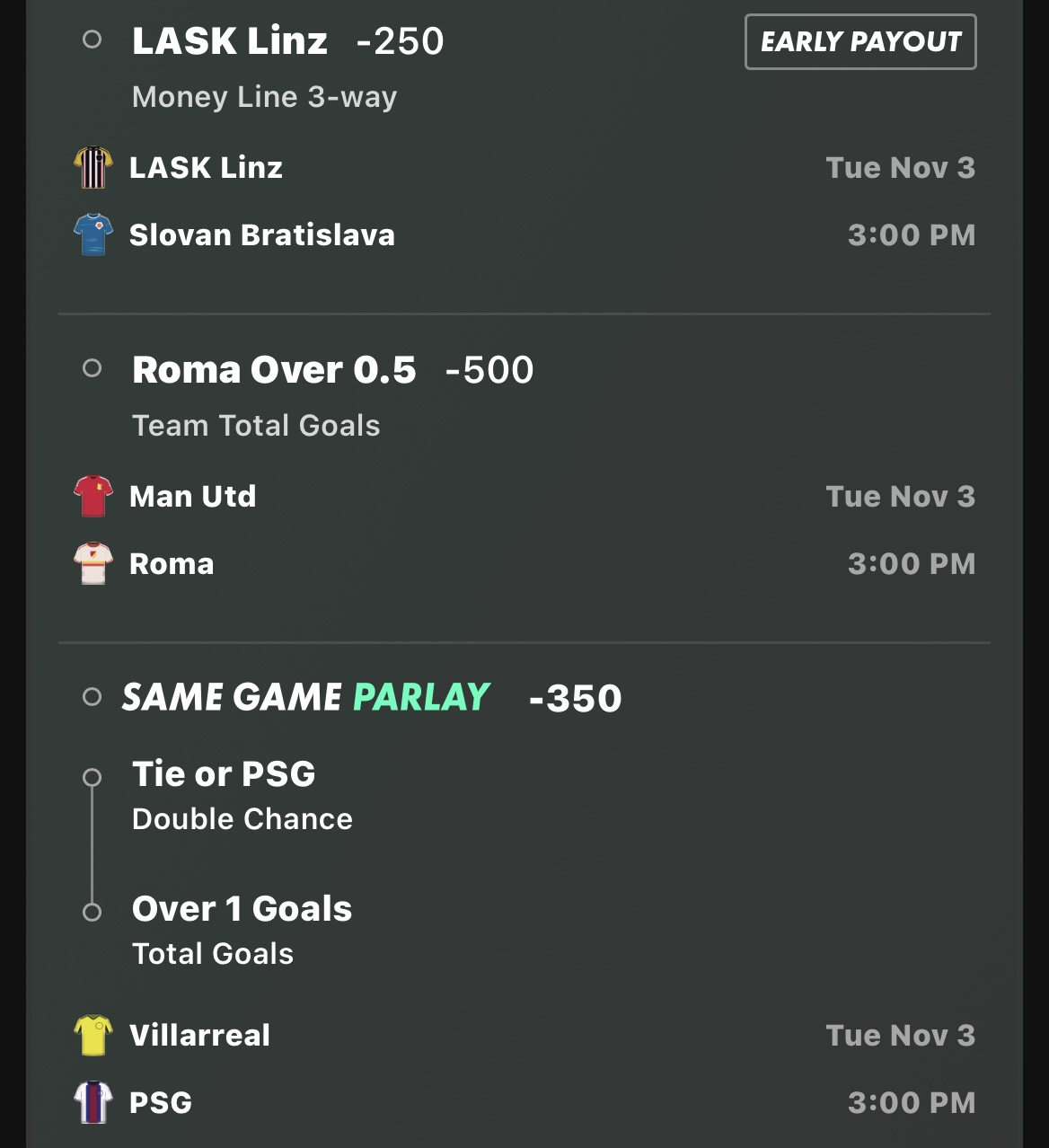
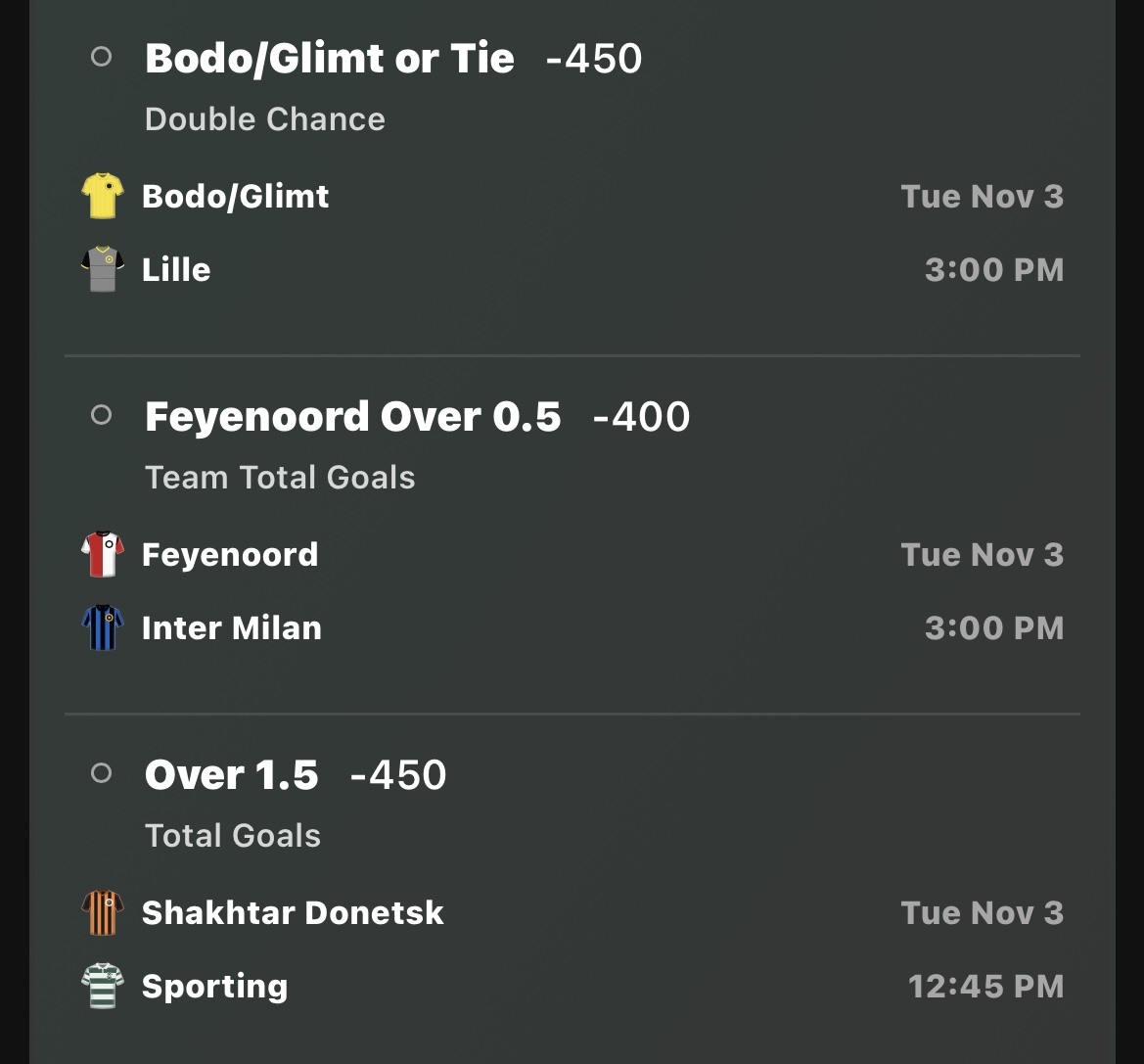
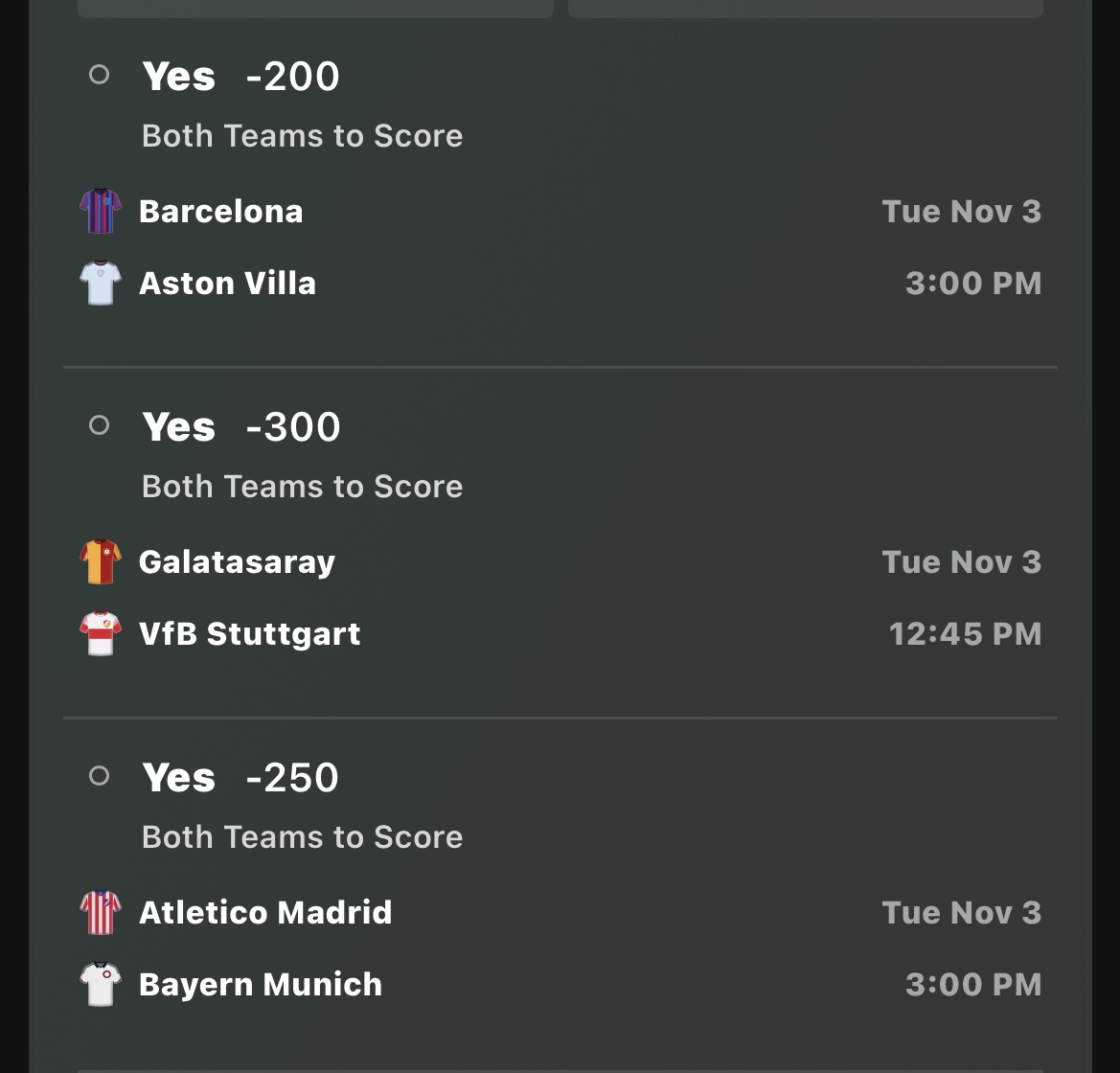
Champions League 2rd November 2026 - My Picks
2% Roma to win vs Manchester United at 33c (good to 40c)
OR
2% Roma not to lose vs Manchester United at 55c (good to 65c)
OR
Some combination of the above
1% Manchester United vs Roma over 2.5 goals at 64c (good to 68c)
1% Manchester United vs Roma over 3.5 goals at 42c (good to 45c)
1% Manchester United vs Roma both teams to score at 65c (good to 69c)
1% Aston Villa +1.5 vs Barcelona at 42c (good to 45c)
1% Aston Villa +2.5 vs Barcelona at 62c (good to 66c)
1% Atlético Madrid not to lose vs Bayern Munich at 56c (good to 60c)
1% Inter Milan to win vs Feyenoord at 50c (good to 55c)
We have some interesting games in this week's Champions League so let's get right down to it.
Manchester United vs Roma
It has been a torrid time for Manchester United under Michael Carrick this season and especially since returning from the international break. United have not won in the last nine games and they have drawn twice and lost four times since the end of the international break. United's underlying metrics look horrendous too - there is not a single game where you can say they were unlucky to lose and United have dropped five points out of six in games where they had a man advantage due to an opponent receiving a red card. Their overall distance covered in games is unremarkable but their high intensity sprints have been a source of concern all season in which United have never truly looked in control of any game.
Tonight at Old Trafford United host Roma managed by Gian Piero Gasperini, who employs an aggressive positional system with a man orientated press. United have struggled with high pressing teams for a long time but they haven't encountered a team that employs a man orientated press quite like Gasperini's, at least not since they faced his old Atalanta side five years ago. Admittedly United did draw and win one of those games but this Roma team is a different beast, they're challenging for the Scudetto and they have scored the second most goals in the European top leagues, alongside Real Madrid and behind only Barcelona.
A recent positive for United was their first half against Chelsea, in which they were able to find space on the break and really should have been leading at half time. In the second half Chelsea took the lead and Lisandro Martínez was then sent off for two yellow cards in quick succession, with the second leading to a penalty. Chelsea was not the worst opponent for them tactically as they attack but they don't counterpress intensely to win the ball back so that meant when United won possession of the ball, they not only did not have the same risk of losing it immediately, they also had the chance to play it quickly down the other end. I expect United will still have transition opportunities against Roma, which is why I like both teams to score and the total going over, but Roma's press will mean that if United are in anyway sloppy in possession while playing it out from the back, Roma will be ready to pounce. Their press is particularly aggressive because their defenders are willing to follow their markers further than most would be willing to do in other systems. This means they can build quick and dynamic attacks but they can also give up space going the other way.
United under Michael Carrick are in a desperate position and right now I wouldn't have them favourites against a very dangerous Roma team. Real Madrid showed a way to trouble Roma in their 4-3 comeback but Real Madrid is a very different beast again and that comeback came in a game where Gasperini made defensive substitutions that sacrificed control over the game. I don't think United are well enough equipped to apply that kind of pressure, especially without Benjamin Šeško to provide an aerial threat for balls into the box.
Barcelona vs Aston Villa
Games involving Barcelona have been goalfests and I don't expect this game to be lacking in goals either. What I am focused on is the shape of the game and how that affects the goal distribution. Under Hansi Flick Barcelona are willing to play a very high defensive line allowing them to compress the space and keep up their relentless attacks. Barcelona by the same token leave space in behind for anyone who's willing to exploit it. Not every team does because that is easier said than done but I would give Aston Villa under Unai Emery a good chance to do that. His teams are tactically pragmatic and flexible, willing to tailor their approach to their opponents. This works best when Emery has longer preparation time but since Barcelona has such a consistent playing style it is easier to map out what must be done. I would expect Aston Villa to play pragmatically, to press selectively but without showing too much space at the back and to counterattack quickly into the space behind Barcelona's press. Aston Villa's win against Club Brugge showed that they are able to find that space behind that press and if they do they certainly have the tools to score a couple of goals.
Atlético Madrid vs Bayern Munich
This is a tough spot for Bayern Munich right now because Vincent Kompany is still absent from the touchline after a health scare and Bayern Munich also have a number of injuries, with Michael Olise fit to play after picking up a knock against Borussia Dortmund but not guaranteed to play. Atlético Madrid are second in La Liga two points behind Barcelona and their 2-0 win over Levante at the weekend showed the growth of a system that allowed them to build a transition from sustained possession in front of their own box. Diego Simeone may not have laid out the blueprint for tonight's game but he has indicated that Atlético Madrid's approach won't be attack attack attack. Against a team like Bayern Munich that presses and attacks so aggressively, I expect Atlético Madrid to defend compactly like they have done against Real Madrid and Barcelona over the past year and to attack quickly into the space Bayern Munich leaves behind. Bayern Munich will still attack even when they have injuries so I expect the transition opportunities to be there and Atlético Madrid certainly have the players to take advantage of them.
Feyenoord vs Inter Milan
One of the bemusing things about Inter Milan is how often they do not start games on the front foot and yet mount enormous comebacks in the closing stages of games. In Serie A they have consistently been able to win games with late pressure but this approach has not worked quite so well in the Champions League. I suspect their approach is particularly well suited to playing against the man orientated systems of Serie A but the Champions League has more zonal systems. Feyenoord play a high pressing style that tends to leave space behind their full backs and that's exactly the kind of space that Inter Milan can exploit quickly on the break. Inter Milan do have some absences to contend with but their system still functions when the players are replaced: they press high and they attack relentlessly with overloads from their wing backs and an aerial threat in the box. Defending late in the game is not what you want to be doing against Inter Milan and Feyenoord have already shown against Barcelona that they have a vulnerability to opponents who consistently target the space behind their defence.
Let's hope for some exciting games!

In this edition of "Master Class", we're gonna look at Prediction Markets vs Sportsbooks, and why the Prediction Markets are the Future of Sports Betting!! Come join us, as we try to provide you with all the tools to STACK YOUR NICKELS TO THE CEILING!! Feel Free to drop any questions you have in the comments!! Hope This Helps My Friends!! Good Luck, Good Gamblin, & Have The Day You Deserve!!
-Crickett
Two conflicting trends dictate the Senate outcome in 2026. The map heavily favors Republicans, as the competitive Senate seats up lean heavily Republican. By contrast, the election context heavily favors Democrats, with war, recession, realignment and scandal tipping in their direction. A deeper dive reveals why prediction markets still likely undersell Democratic prospects.
First, the idea that Senate midterms favor the party out of power in the White House is belied by both recent and a century of history of Senate elections. Unlike the House, only a third of Senate seats face election in any midterm, and that map dictates outcomes unless the election context is particularly bad for the incumbent party.
Consider that the highly unpopular Biden didn’t lost any net Senate seats in 2022 and Trump added Senate seats in the Democratic friendly cycle in 2018. Equally, Clinton didn’t lose net Senate seats in 1998 nor did W. in 2002. Even low-approval election cycles like 1966 and 1982 didn’t produce a big swing in the Senate. Indeed, since 1934, the party in power only lost 10% or more of their Senate seats (4+) less than half of the time. Democrats need a flip of exactly that — at least 4 Senate seats — to retake power in the Senate.
Then take a look at the map, and you can see the reason for optimism in GOP circles and some traders in the prediction markets. Only 2 GOP-held seats are in states Trump won by less than double digits, while 2 Democratic-held seats are in states Trump won, and one of those GOP held seats features a long-time incumbent who typically runs double-digits ahead of the GOP norm (Collins in Maine). This is why the GOP entered the year believing odds of losing the Senate were remote, and the prediction markets mostly concurred.
But this ignores the counter-trend: the degree of election dismay with the incumbent party in the White House, and the reasons for that dismay. Presidential job approval has not been a neat proxy for Senate midterms because it depends on the reason for that dissatisfaction in the electorate. Four factors drive Senatorial midterms: war, recession/cost of living, realignment, and scandal. When two of those four factors are not present and don’t dominate, then the incumbent party’s odds of losing 4+ Senate seats drops to less than 20%. By contrast, when two of those four factors are present and do predominate, then the odds of the incumbent party losing 4+ Senate seats rises to 100%. Indeed, the median number of Senate seats lost when some combination of war, recession, realignment and scandal, are present, the White House party loses at least 8 Senate seats.
A few examples: while FDR added Senate seats in 1934 midterms, he lost 9 in 1938 midterms due to the combination of recession and scandal (trying to stack SCOTUS). 1942 and 1946 gave us war and recession to cost Democrats 8 and 12 Senate seats alike. 1950 gave us war again and scandals concerning the war costing Democrats 5 Senate seats. 1958 gave us recession and scandal, costing Ike 15 Senate seats. While JFK added Senate seats in 1962 and Nixon added Senate seats in 1970, only Watergate and stagflation in 1974 or the combination of Iran Contra and vulnerable class of 1980 incumbents cost the incumbent party 4 or more Senate seats until the realignment election of 1994, where evangelicals shifted their down-ballot voting to the GOP en masse. It took war and scandal in 2006 to see the Senate switch 4+ Senate seats again.
That’s the story of 2026: a very GOP favorable Senate map versus a very Democratic friendly election cycle. The GOP enters election season with all four factor present: war, recession/cost of living, realignment, and scandal. The Iran War was already deeply unpopular, and it’s impact on the economy in gas and diesel prices turns Americans sour on their current economic prospects, as wages fall behind, housing and health care feel increasingly unaffordable, labor force participation continues to drop, the the mirage of AI keeps the GDP just above a technical recession. The Epstein scandal remains one of the worst scandals in American political history, and Trump managed to associate himself deeply with the scandal in his handling of it. Then the realignment, as the new Trump 2024 voters joined the Obama-Trump converts of 2016 in abandoning GOP identity, already evident in surveys and primary participation.
A quintet of voter groups appear to be realigning away from the Republican brand — hispanic voters, black voters, industrial area voters, libertarian-leaning voters, and war-skeptical voters alike. This realigning electorate shows up disproportionately in key Senate contests. The war-skeptical voters in states like Maine, New Hampshire, Ohio, Michigan, Iowa, Montana, Nebraska, and Alaska (these are the states W failed to gain in between 2000 and 2004 due to the Iraq War before it even turned unpopular). The hispanic voters in states like Florida and Texas. The African-American voters in states like North Carolina and Georgia. The industrial voters in Ohio and Michigan. The libertarian leaving voters in states like New Hampshire, Alaska, Texas and Florida.
Thus, many of the states that seem “Safe” on the map are anything but, as their realigning electorates shift back against the Republican brand, with all of them having recent histories in electoral cycles of favoring Democrats or being true swing states. Take states like Florida and Texas where suburban margins began to erode for the GOP in the Trump era but countered that by massive margin shifts in hispanic and black precincts. Primary participation, voter identification, and public opinion surveys show those black and hispanic voters shifting back massively away from the GOP brand, which, given the erosion in some suburban areas and losses with younger generations, makes states Florida and Texas closer to competitive than double-digit leans.
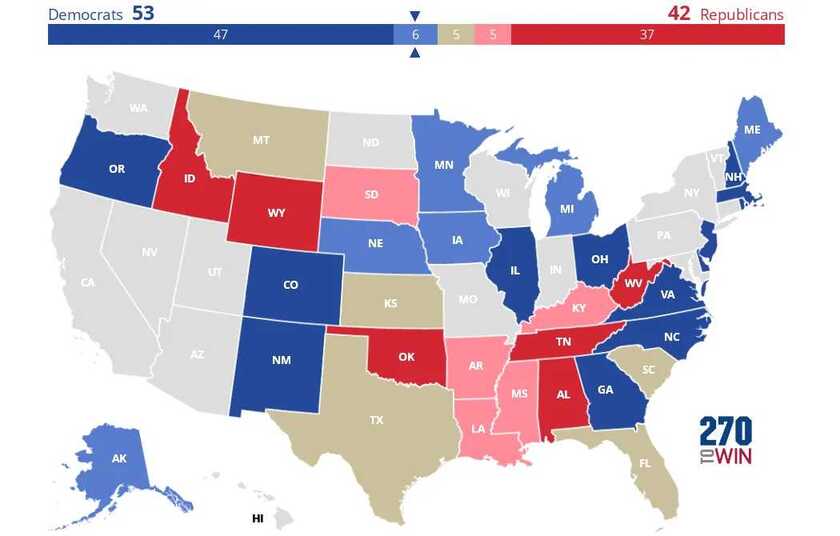
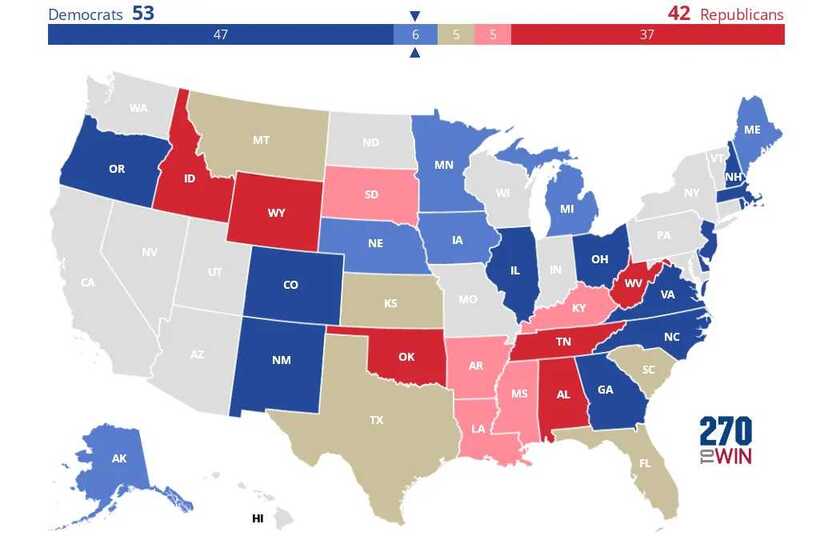
In big swing election cycles, even “safe” Senate seats can suddenly turn razor close, as Bob Dole found out in 1974, barely holding on to his Kansas seat before being the VP nominee two years later. Strong independent candidates in Kansas, Nebraska, South Dakota and Montana may pose a unique threat to GOP held seats, as the Nebraska race in 2024 showed, with Osborn running 17 points ahead of Harris’ margin in the state. Democrats field the much better candidate in Ohio with a proven track record of out-performing Democratic margins in the state, while the Texas GOP nominee faces abandonment from his own party after they spent over $100M bashing him in the state for a disliked party incumbent. Alaska primary results suggest the Democratic nominee already holds the edge in that ranked choice voting state, while the famed cross-over support for Collins in Maine appears to be fading with newer generations taking over the voter rolls. My current map would be as follows, with surprising closer-than-expected races in Montana, Kansas, Louisiana, Florida, Mississippi, South Dakota, South Carolina and Kentucky, and a median map of Democrats holding 53+ Senate seats after the 2026 elections.

If past is prologue, the map won’t save the GOP in 2026, and an ever bigger tsunami may be incoming than anyone in Washington expects.