



SportsPicks
Politics • Investing & Finance • Sports
All your sports information for those investing Vegas-style in the outcomes of sports games. Predicting games against the line in all sports, especially football, American and English style.
Interested? Want to learn more about the community?
Live Streamed on January 21, 2026 11:01 PM ET
LIVE: Betting w/ Barnes, Wednesday, January 21, 2026

Top topics: NFL Championship Deep Dive, and answering all your questions LIVE...

01:02:42
Interested? Want to learn more about the community?
What else you may like…
Videos
Podcasts
Posts
Articles
The Association - 3/3/26

ANY PICKS MADE IN THIS VIDEO ARE NOT SPORTSPICKS "OFFICIAL PICKS"

00:31:18
Puck Around & Find Out - 3/3/26

ANY PICKS MADE IN THIS VIDEO ARE NOT SPORTSPICKS "OFFICIAL PICKS"

00:24:38
The Association - 3/2/26

ANY PICKS MADE IN THIS VIDEO ARE NOT SPORTSPICKS "OFFICIAL PICKS"

00:14:06
SEC Preview Podcast

A full breakdown of every team in the SEC, including talent analysis, coordinator concern, and schedule forecasts, with win total expectations. Enjoy!

SEC Preview Podcast
Smokehouse Mike's NCAAB

March Madness final four recap and Championship preview...

Smokehouse Mike's NCAAB
Smokehouse Mike's NBA
Live Chat for 2025

Open until the end of the year, and pinned here.

Well, at least that cashed. Viva is talking about a Kalshi lawsuit today, hopefully it’s for the Comey arrested issue!

post photo preview
OFFICIAL PICKS: Politics, Wednesday March 4, 2026

Elevate to 5%
Will Iran effectively close the Strait of Hormuz for 7+ days? YES 44% (ok to 65%)

post photo preview
Barnes Betting Report: Midterm Elections

Historical Context

  • Without war, recession or major scandal, the odds of the White House party losing 25+ House seats & 5+ Senate seats is a relative rarity in the post-WW2 modern era, covering 20 midterm elections. The Senate saw 5+ flips in 1946 (war ending), 1958 (recession), 1986 (midwest/farm recession), 1994 (evangelicals join the GOP down ballot), 2006 (Iraq war), 2010 (GFC recession) * 2014 (Obama hangover). That means in 15 of the last 20 midterms, the Senate saw little shift. Indeed, the party holding the White House has just as often gained seats in the Senate as lost them, including the last 2 midterm election cycles. The House saw 25+ house seats flip in 1946 (war ended), 1950 (Korean War), 1958 (recession), 1966 (Vietnam war), 1974 (Watergate), 1982 (recession), 1994 (evangelicals join GOP down ballot), 2006 (Iraq War), 2010 (GFC), and 2018 (anti-Trump). The House, with all seats up every cycle, are more vulnerable to swings against the party in the White House, but claims of inevitability are greatly overstated. Even the House is only 50-50 in the post-WW2 era in massive swings, with the most vulnerable swings occurring when one party has a lopsided edge in the House. Point in fact, since 1986, 60% of the time the House has not had a major 25+ swing in seats in midterm elections. The same rule holds for each part of Congress -- without war, recession or major scandal, massive shifts are far more uncommon than common. That said, when a war is raging or just ended, a recession haunts the economy, or a major scandal consumes the news, the odds of a major shift in at least one of the two houses of Congress is a perfect 7-for-7, and the odds of a major shift in both houses of Congress is 6-for-7. Without a recession, war or scandal, the odds of a big swing in both houses of Congress drop dramatically to just 2-for-13, with both coming in major realignment elections (evangelicals join GOP down ballot in 1994 & old Jacksonian Democrats from the reverse-L of eastern Oklahoma to western North Carolina, up through Kentucky and Ohio of Appalachian hearland swing away from Obama's Democrats). 

2026

  • GOP enters with a 3-vote edge in the Senate, with 53 Republicans, though they must lose 4 seats to lose control (due to VP's tie-breaking vote), and maybe even 5 (if Fetterman flips to vote with the GOP & Murkowski does not flip to the Dems). GOP enters with a 2-vote edge in the House, with 218 Republicans and 214 Democrats, and 3 vacancies representing 2 Republican-held seats, and 1 Democratic held seat. The Supreme Court's slow action reversing the Voting Rights Act limits the chance of effective redistricting, while redistricting currently net favors Democrats if the Virginia redistricting succeeds and the Texas redistricting in Mexican ancestral areas of Texas showed they likely trend Democratic in the recent primary. The current Iran war, the risk of looming recession, the possibility of lurking scandals, and the lost realignment of the Trump 2024 coalition all point to this cycle being a major shift in both houses. Baris' polls amongst the extremely enthused show Democrats with a double-digit lead on the generic ballot, unheard of in the contemporary era since the realignment of evangelicals in 1994. 

2026 Senate

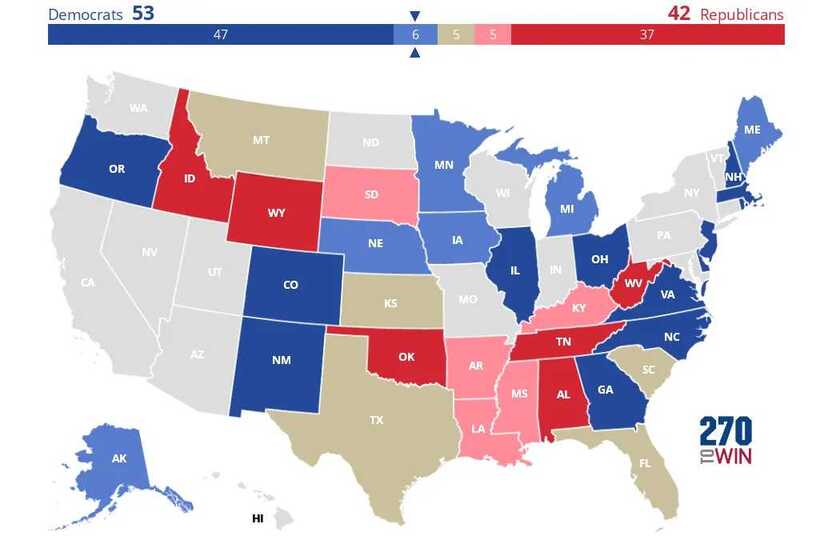
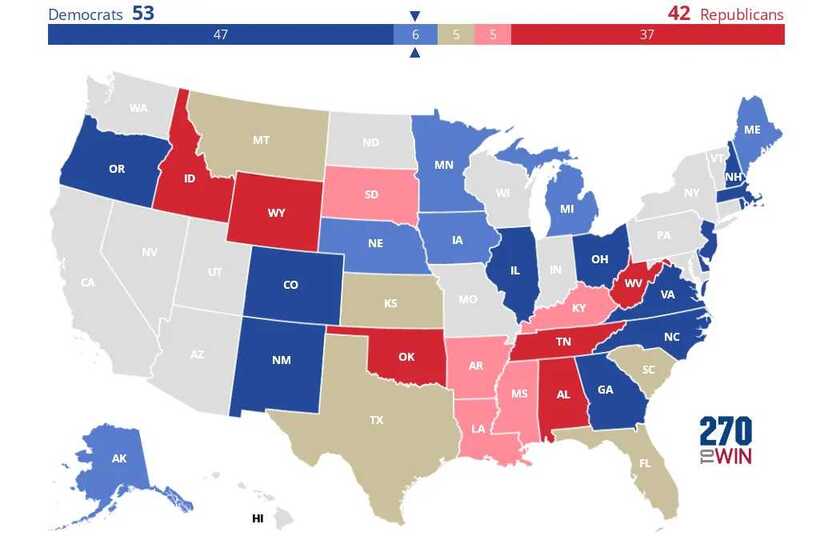
  • The competitive seats identified by third party observers are: Maine, Michigan, Ohio, Iowa, North Carolina, Georgia, South Carolina, Texas, Nebraska, and Alaska. Currently, Republicans old all but 2 of these competitive seats, making them more vulnerable due to the map of seats up for election this cycle. Internal GOP polls and Baris' polls show the races already as a dead heat in Ohio, Iowa and Alaska, with the GOP candidate down in Maine, Michigan, North Carolina, and Georgia. Should Cornyn win the nomination in Texas and Graham in South Carolina, as well as the establishment candidates prevail in the GOP primaries in Iowa, GOP vulnerability increases due to up to one-third of GOP primary voters saying they will not vote for either in the general election. My odds for these states voting Democrats in the Senate are as follows for these 10 seats:
  1. Michigan: 95%
  2. Maine: 85%
  3. North Carolina: 80%
  4. Georgia: 75% 
  5. Ohio: 65%
  6. Alaska: 65%
  7. Iowa: 60% (75% if Carlin loses the primary; 50% if Carlin wins the primary)
  8. Texas: 50% (65% of Cornyn is nominee; 35% if Paxton is nominee)
  9. South Carolina: 50% (65% of Graham is nominee; 35% if Lynch or Dans is nominee)
  10. Nebraska: 40% (Independent is one to watch)
  • Senate Overall in 2027: 53-47 Democratic, with Murkowski likely to flip to the Democrats, and Fetterman staying put on the Democratic side, increasing that to 54-46 in voting terms. I set the odd of the Senate going Democratic at 80%. 

House 2026

  • The key competitive seats are in the industrial/rural midwest and the heavily Hispanic southwest, with both constituencies recent GOP converts now returning en masse to Democratic voting habits their voting ancestry supports. These are both war-sensitive demographics, as well as recession-sensitive demographics. The Democratic message of the Epstein Class vs the Working Class resonates deeply with these voter groups. Meanwhile, voter enthusiasm amongst GOP-leaning independents hit new lows in a range of voter surveys, evidenced by the 27-0 edge Democrats enjoy in flipping state legislative seats over the last 6 months or so & the lopsided Democratic edge in turnout in the Texas primaries (exceeding GOP turnout for the first time since 2002). I forecast only 1 currently heald Democratic seat flipping to the GOP: Texas CD 32; by contrast, I forecast 33 seats flipping to the Democrats, for a seat profile in 2027 House that is 246 Democrats, and 189 Republicans. I see the odds of the House going Democratic at 98%. These are the seats I see as likely flipping to the Democrats in 2026 midterms: 
  1. Alaska At Large
  2. Arizona 1
  3. Arizona 2
  4. Arizona 6
  5. California 1
  6. California 6
  7. California 22
  8. California 48
  9. Colorado 3
  10. Colorado 5
  11. Colorado 8
  12. Florida 7
  13. Iowa 1
  14. Iowa 2
  15. Iowa 3
  16. Michigan 4
  17. Michigan 7
  18. Michigan 10
  19. Montana 1
  20. Nebraska 2
  21. New Jersey 7
  22. North Carolina 11
  23. Pennsylvania 1
  24. Pennsylvania 7
  25. Pennsylvania 8
  26. Pennsylvania 10
  27. Tennessee 5
  28. Texas 15
  29. Utah 1
  30. Virginia 1
  31. Virginia 2
  32. Wisconsin 1
  33. Wisconsin 3
Read full Article
post photo preview
Thoughts on Last Night

Around around she goes; we she ends, nobody knows. Only truly beatable infinity, unless you believe in luck So The Good Thief lead character explains as he sees the ball chase around the roulette wheel. But it wasn't luck that lost me last night; it was failing to follow my own methodologies for the best decision making in the world of prediction markets.  

Many of my assumptions held (Mamdani bets cashed to a profit, the Democratic sweep happened, and Morris County flipped to Sherrill, while closest race was the Virginia Attorney General), but a big one didn't -- that 2025 would not bring a record-setting Democratic wave. The wave crested like a tsunami, felt coast to coast, from the northeast to the southwest, from the midatlantic to the mountains, from the industrial midwest to the southern countryside, effecting small town mayoral races in Pennsylvania to Public Service Commission statewide gigs in Georgia, from legislative districts with 36 year incumbents in ruby red Virginia heartland to the most revolutionary Mayor ever elected in New York City since Henry George's failed effort signaled the rise of Populism a century+ ago. Candidate quality did not matter. Candidate spending did not matter. Incumbency did not matter. Job approval did not matter. Scandals did not matter enough or did not matter at all. Get out the vote efforts did not matter. This was an angry electorate seeking vengance, and finding its expression wherever they could. 

That was my first mistake, and it was a mistake, rather than bad luck. I assessed the wave risk at 10%, when it was manifestly much higher. All I needed to do was listen to....myself. I went back and watched my last episode w/ Baris and an episode a few months ago with the Duran, the latter where I previewed a collapse in GOP support if Trump didn't escape the foreign focus & wars, delivering only to the donor class. I spoke often of the new MAGA that began to build in 2023 -- young, working class, often minority, deeply unhappy with the political direction of an elder class they are rebelling against, as easily tempted by left populism as right populism, and as easily susceptible to political apathy and agnosticism as engagement & activism. The shutdown was actually a negative tipping factor for these voters, as the SNAP issue played poorly with them, while enraging part of the Democratic base otherwise unenthused up to that point. I made two errors in methodology & one error in psychology I detail below. 

The second error was bankroll percentage. It was a single race in a single state; as such, keeping it closer to 5% made more sense than expending it to 34%, especially if more cognizant of the risk. It also shifted my stronger risk appetite onto others, and that was en error I usually well avoid. If I had listed every major election pick this year at 5%, we'd be in the black; even last night, splitting 5% bets amidst the 3 elections, would have only been a modest loss, given certain underdog bets hit with Mamdani. As I often say, but forgot here to practice -- bankroll discipline is the most important aspect of successful trading in the markets, sports or politics. 

The psychological error was getting attached to a pick, and not relooking at it from scratch anytime new information arives. A natural tendency is to stay committed to something merely because of prior committment rather than look at it completely anew, and being afraid of taking a loss when once vested in so much hope of a win. 

Areas to improve:

  • using the methodological approach of motivated reasoning -- you cannot make reason the master of motivation, but you can use motivation to master reasoning. The Elephant in the Brain. I needed to put myself in a position to take the opposite side of each pick, make the best argument possible for it, and then test it against the other side. In this respect, one way to best maximize this is to include substack-style articles on this site laying out the argument, and letting the community respond -- as several sagely warned in this case, which can dramatically improve the quality of reasoning;
  • tracking all data available -- for example, whether an off-year election could be a wave election that might have polls actually overstate the White House incumbent party that even the GOP the polls tend to be biased against & digger deep dives into possible explanation for a poll's results (for examply, Miyares surge was partly fog, by Democratic voters choosing undecided rather than voting against b/c they didn't want to admit they secretly supported the murderous texts of their Attorney General candidate; 
  • waiting until election eve and election day, especially in the US elections, as the volatility proffers the best opportunities, and the best information is then availabile if timely processed; 
  • finding a way to better track live-time data on election night by reemploying an older technique from my political campaign days -- prior to the election, predicting the expected % for each county (and key precincts when available) in terms of expected vote share & vote distribution, which can most accurately forecast where an election will go, to get ahead of the markets (the big models out there completely crashed last night, including the $250K new-and-improved Decision Desk model;
  • avoiding all bubbles & returning to getting into the head of a wide range of voting groups, something I long excelled in, but have to dedicate myself to these days due to inhabiting a political world more these days that can make me too responsive to criticism -- "hey Barnes, you're a panican; hey Barnes, your Barnes/Baris voter is mythical; you don't get it, Jack is a lock in New Jersey". I need to step into the minds of these independent voters, and keep listening to the independent podcasters who were a useful signal in 2024 and 2025 -- see how Andrew Stein, Tim Dhillon, Joe Rogan, Dave Smith, Theo Von -- all left Trump train in the summer of 2025;
  • staying within the 5% max recommendation on a single election in a single state unless extraordinary reason supported by extraordinary evidence recommends otherwise, and including the assumptions in those extraordinary picks such that the pick can be sold off quick if those assumptions show other signs in the data

Truth is, losses teach you more than wins. Despite as much as I try to track the underlying assumptions of winning picks, the stay-up-top-3-am reearching and obsessing motivation comes from tough losses. In addition, I learn the values of patience, forbearance, discipline, emotional equilibrium, self-belief, as well as better improving a sound methodological approach through "putting my money where mouth is" and sharing it with the world for public accountability and transparency improving decision-making skill over time, maintaining humility when the trap of hubris would otherwise ensnare.

After three decades of successful US elections, my setback in 2022 dramatically improved my analysis for 2024, proving fantastically profitable. Thanks to everyone for participating, hope you continue to partake in the community, and if I were a betting man, and I am, I would wager we will be profitable again, in matters of pocketbook, principle and politics very soon. 

Read full Article
post photo preview
OFFICIAL PICKS: SPORTSPICKS, WEEK 16, 2024 -- Tuesday, December 10, 2024

2% max recommended unless otherwise noted. 1% max recommended for soccer. 


Only for Supporters
To read the rest of this article and access other paid content, you must be a supporter
Read full Article
See More
Available on mobile and TV devices
google store google store app store app store
google store google store app tv store app tv store amazon store amazon store roku store roku store
Powered by Locals